Why Your Roadmap Breaks Down With Outsourced Teams
Managed Teams
Here is something that happens constantly and almost never gets named. A company brings on an outsourced engineering team. The onboarding goes reasonably well. The first sprint ships. Then, around week six or eight, something starts to feel off. Deliverables are technically correct but somehow not quite right. Priorities that seemed obvious to the product team weren't obvious to the engineering team. The roadmap that everyone agreed on at kickoff is no longer what either side is actually working toward.
This gets blamed on communication. On timezone gaps. On cultural differences or on the outsourced team not being as good as expected.
Almost always, the real cause is simpler and more structural: nobody clearly defined who owns the roadmap once it crossed the organizational boundary from your team to theirs. That ambiguity is quiet at first. By the time it becomes visible, it has already cost you weeks.
This article names the problem precisely, introduces a framework for solving it, and gives you the velocity data you need to build roadmaps that actually survive contact with an outsourced team.
The Two Roadmaps Problem: Why Alignment Breaks Down
There is a thing that happens in almost every outsourced engineering relationship and nobody has a name for it. We call it the Two Roadmaps Problem.
When your engineering team is in-house, there is one roadmap. Your product manager owns it, the engineers work from it, and when something changes, everyone knows about it in the same meeting, the same Slack message, the same conversation. The roadmap and the delivery plan are the same document in the same room.
When your engineering team is outsourced, two roadmaps start operating simultaneously:
- The product roadmap: what your internal team intends to build, why, and in what order informed by your business strategy, your user research, your investor conversations, your competitive context.
- The delivery roadmap: what the outsourced team believes they are building, based on the brief they received, the sprint backlogs they have been handed, and the context they have been given which is almost always incomplete.
In a healthy relationship, these two roadmaps are synchronized. In most relationships, they quietly diverge. The divergence is not dramatic. It happens incrementally. A feature gets deprioritized on your side without a clear update going to the engineering team. A technical dependency surfaces that changes the sequencing on their side without being reflected back on your roadmap. A business context shift happens that the outsourced team has no visibility into.
By the time the divergence becomes visible, you are usually three sprints into building the wrong thing, or the right thing in the wrong order, or something technically correct that solves a problem that is no longer the priority.
This is not a communication problem, exactly. It is a structural problem. According to a 2025 product roadmap alignment study by ITONICS, most roadmap failures come down to one missing layer: the explicit definition of who owns the decision when priorities need to shift. When that decision lives in one organization and the execution lives in another, the gap between them is where the Two Roadmaps Problem grows.
The Ownership Transfer Framework: Three Levels, One Clear Model
The solution to the Two Roadmaps Problem is not more communication. It is defined ownership. Specifically, it is a clear, documented, agreed answer to this question: at what level does your outsourced team own the roadmap, and at what level do you?
We call this the Ownership Transfer Framework. It has three levels. Every outsourced engineering relationship sits at one of them, whether or not you have named it. The difference between a healthy engagement and a broken one is usually whether both sides know which level they are operating at.
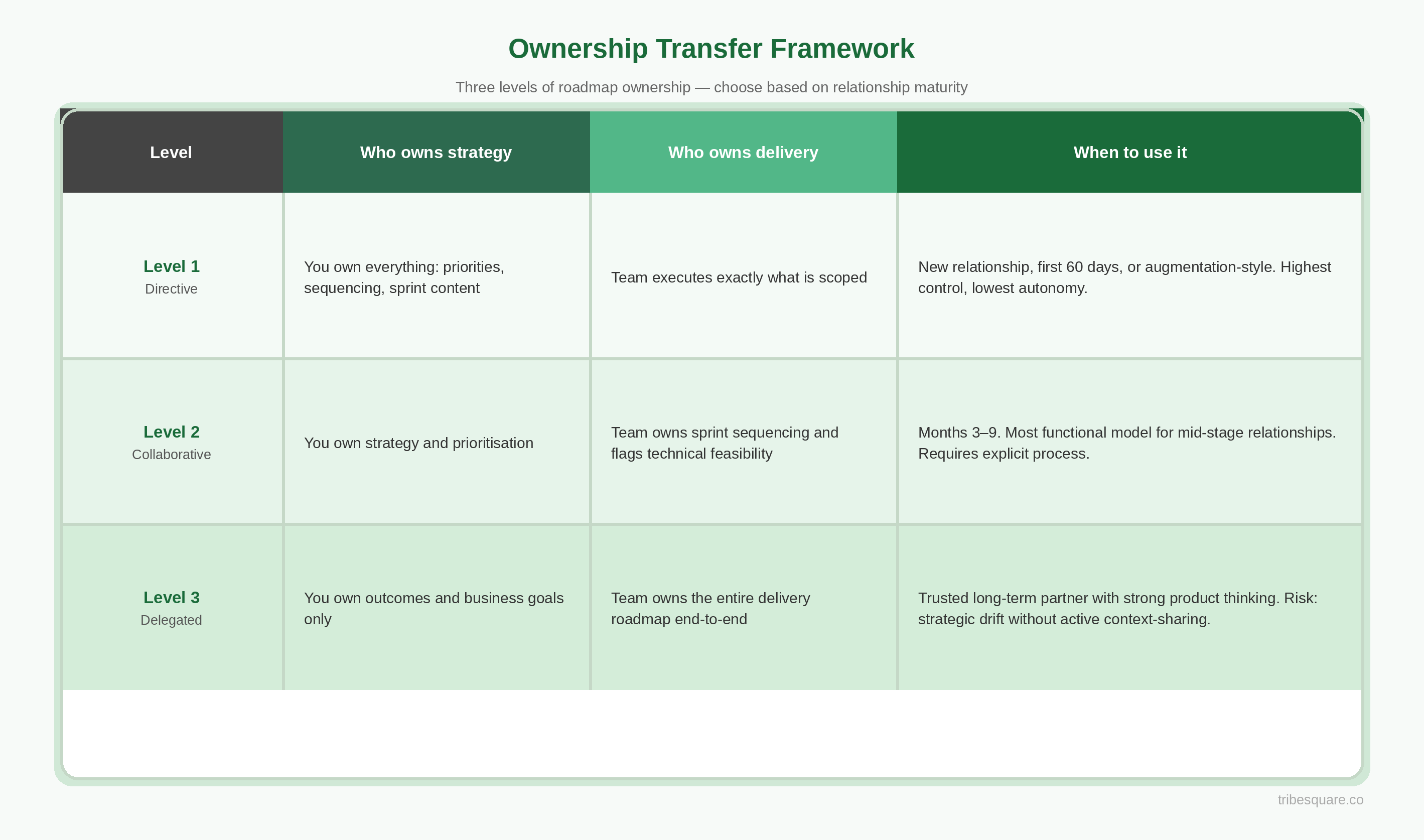
How to use this framework
The most important insight from this model is that the right level changes over time. Most relationships should start at Level 1, move to Level 2 around month two or three once the team has demonstrated they understand the product context, and only move to Level 3 after sustained evidence of strong product thinking from the outsourced team. Skipping Level 2 and jumping to Level 3 with a team that has not earned it is the most common cause of strategic drift in long-term outsourcing relationships.
This maps directly to what Gallup's 2024 workplace research identifies as the accountability gap: when role responsibilities are ambiguous, team productivity drops by an average of 22%. In an outsourced relationship, that ambiguity does not just affect individual performance — it compounds across every sprint.
Assigning ownership in practice
Ownership is not just a verbal agreement. It needs to live in three specific places for it to actually work:
- In the contract or engagement letter: a section that explicitly names which level of ownership applies and under what conditions it can change.
- In a RACI matrix: a document that specifies who is Responsible, Accountable, Consulted, and Informed for each decision type in the roadmap — priority changes, scope changes, technical feasibility flags, and release sequencing.
- In a living decision log: a shared document (Notion or Confluence work well) where every roadmap decision, change, and the rationale behind it is recorded. This is the artefact that makes ownership visible and reviewable.
A 2024 Gartner report on distributed teams found that assigning accountability through a digital RACI chart reduces project overlap by up to 23% and lowers interdepartmental conflicts by 17% on average. These are not abstract governance exercises. They are the specific operational difference between a roadmap that holds and one that drifts.
Practical starting point: before your next sprint kickoff with an outsourced team, spend 20 minutes writing down the answer to this question, who has final say on prioritization changes mid-sprint? If you and the outsourced team lead would give different answers, you are operating without defined ownership
The Velocity Gap: Why Your First Roadmap Milestone Will Almost Always Be Late
Even if you solve the ownership problem perfectly, there is a second structural reality that most roadmaps ignore: outsourced teams do not operate at full velocity on day one. Every article about outsourcing tells you to set realistic timelines. Almost none of them tell you what realistic actually means in numbers.
Here is what the research and operational data actually shows about new engineering team ramp-up:
According to Deel's time-to-productivity research, software engineers typically take six to twelve months to reach full productivity in a new codebase and environment. In an outsourced context, structured onboarding compresses this significantly but even the most well-documented onboarding process has a meaningful ramp curve.
A staff augmentation case study published by Full Scale showed that senior developers with 7 or more years of experience and clear initial tasks reached 70 to 100 percent productivity within 7 to 14 days. With junior developers, async-only communication, or unclear initial tasks, the same ramp takes 30 to 90 days. The gap between those two outcomes is driven almost entirely by how the onboarding is structured not by talent.
The practical implication for roadmap planning is this: the velocity your outsourced team demonstrates in month three is not the velocity you should be planning against in month one. But most roadmaps are built assuming steady-state velocity from week one. That is why the first milestone is almost always missed, and why the team gets blamed for a failure that was actually a planning assumption problem.
Here is the velocity buffer framework that solves this:
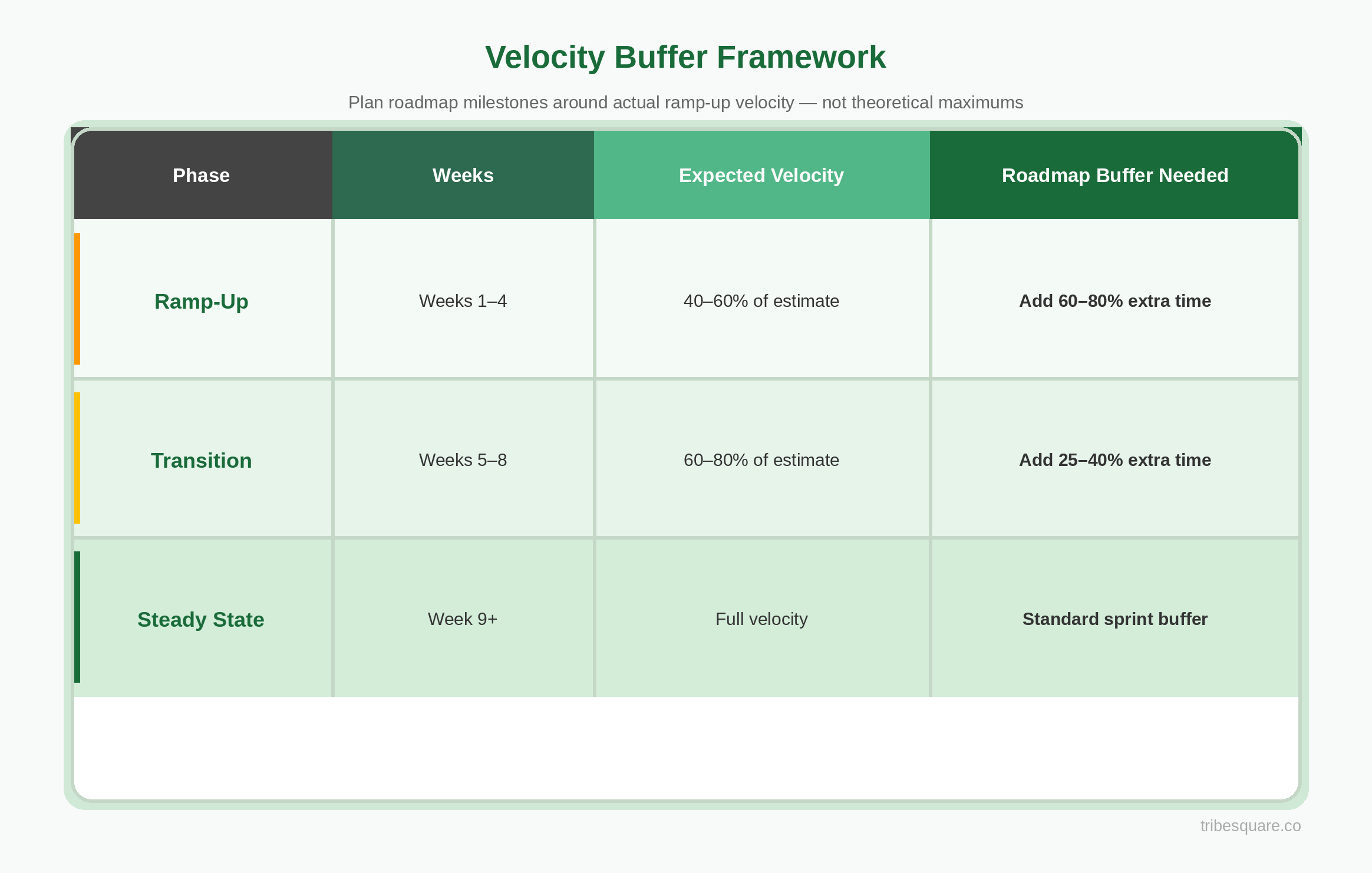
To use this in practice: take your velocity estimate for the first sprint, apply the 40 to 60 percent factor, and plan your roadmap milestones accordingly. If your team estimates they can ship 40 story points per sprint at steady state, plan for 16 to 24 points in weeks 1 to 4 and 24 to 32 points in weeks 5 to 8. Build milestones around those actual numbers, not the theoretical maximum.
The most expensive roadmap mistake: committing to an investor, a customer, or a board on a timeline built around week-one velocity estimates. The first roadmap you build with a new outsourced team should always include an explicit ramp buffer. Write it into the plan. Explain why it is there. It is not pessimism — it is accuracy.
Making the Framework Operational: What This Looks Like Week by Week
A framework is only useful if it can be put into practice. Here is what the Ownership Transfer Framework combined with velocity-aware roadmap planning looks like as an actual operating rhythm.
Before the engagement starts
- Define your ownership level: document it, share it with the team lead, and get explicit agreement. Level 1 is the right default for a new relationship.
- Build a RACI for roadmap decisions: who can change priorities, who must be consulted, who needs to be informed. This takes one hour and prevents dozens of misalignments.
- Set up a living decision log: a shared Notion page, a Confluence space, or even a dedicated Slack channel where every roadmap decision is recorded with a date, a rationale, and who made it.
- Apply the velocity buffer to your milestone schedule: any commitment dated within the first 8 weeks should have a ramp adjustment built in.
During the engagement: the weekly alignment cadence
McKinsey's 2024 Developer Productivity Report shows aligned teams ship 2.3x faster than misaligned ones. The alignment does not happen by accident. It is the product of a specific, repeatable cadence. Here is the one that works:
- Sprint kickoff alignment (30 minutes): product manager and team lead jointly confirm the sprint scope against the roadmap. Any gaps between what was planned and what is being built get surfaced and resolved before a line of code is written.
- Mid-sprint check (15 minutes): a quick synchronous or async check at the halfway point. The only agenda items are: is anything blocked, has anything changed on the product side, are we on track for the sprint commitments? Catching drift here saves the back half of the sprint.
- Weekly async roadmap update from the PM: a 5-minute Loom video sharing context on the next 2 to 3 weeks of the roadmap, any priority shifts, and any business context the team needs to make good technical decisions. This is the 'why behind the what' — the information that turns order-taking developers into product-thinking collaborators.
- Sprint review with ownership lens: not just a demo, but an explicit review of whether what shipped matches what was on the roadmap and whether the ownership model served this sprint well. If it did not, name why and adjust the model.
Managing roadmap changes mid-engagement
Priorities change. That is not a failure of planning, it is the nature of product development. The question is whether your ownership model handles change well or breaks under it.
- Changes that affect the current sprint: must go through the accountable person defined in your RACI. No informal Slack messages that resequence work without a logged decision.
- Changes that affect the next sprint: can be handled at sprint kickoff, but must be communicated to the team at least 72 hours in advance with context on why the change is happening.
- Strategic roadmap shifts: require a dedicated alignment session, not just a message. If the product direction changes significantly, the outsourced team needs the business context to reorient not just a new backlog.
Research from Remote Sparks on distributed product roadmap best practices recommends calculating realistic velocity by accounting for 20 to 30 percent non-coding time including meetings, communication overhead, and context-switching. This buffer is not wasted it is the cost of maintaining alignment across an organizational boundary, and it is cheaper than misalignment.
Tools That Support This Model (And How to Use Them Well)
The framework above works with any toolset. What matters is not which tool you use but that everyone is using the same one. Here is how specific tools map to specific parts of the model:
Linear: strongest for sprint-level tracking where the outsourced team needs to see the direct connection between individual issues and roadmap priorities. Linear's cycle and project structure maps naturally to the velocity buffer model. Best for Level 2 and Level 3 ownership.
Jira: the default for most enterprise relationships. Works well for Level 1 directive ownership where precise sprint control matters. Can become bureaucratic overhead in Level 2 collaborative models without strong hygiene practices.
Notion or Confluence: non-negotiable for the living decision log. Every priority change, scope decision, and ownership clarification should be logged here. This is the document that resolves disputes, onboards new team members, and makes the relationship auditable.
Loom: the most underused tool in distributed roadmap management. A 5-minute video from the PM that shares context on upcoming roadmap priorities does more for alignment than a written update, because it conveys nuance, urgency, and business context in a way text cannot.
A 2024 Atlassian survey found that structured documentation in tools like Confluence or Notion reduces miscommunication incidents by up to 30% and cuts onboarding time for new team members by 40%. The documentation is not overhead. It is the infrastructure that makes the ownership model survive team changes.
One rule worth enforcing: no roadmap decision exists until it is in the decision log. Verbal agreements in sprint calls, informal Slack messages, and hallway conversations that reprioritise work are the exact mechanism by which the Two Roadmaps Problem grows. If it is not written down with a date and a reason, it did not happen.
The Failure Modes: What This Looks Like When It Goes Wrong
All of the above is the model working correctly. Here is what it looks like when it fails and why the failure mode matters as much as the solution.
Failure Mode 1: Operating at Level 3 too early
A company delegates full roadmap ownership to an outsourced team in month two. The team, unfamiliar with the business context, makes technically sound decisions that are strategically misaligned. By month four, the product has drifted toward what is buildable rather than what is needed. Rebuilding costs more than the delegation saved.
Prevention: earn your way to Level 3. It requires sustained evidence of product thinking from the outsourced team, not just delivery competence.
Failure Mode 2: Staying at Level 1 indefinitely
A company stays in directive mode with an outsourced team that is ready for more. The team becomes order-takers. They stop flagging technical concerns because nobody listens. They stop suggesting better approaches because it has never led anywhere. The relationship produces technically correct work at below-potential quality. The best developers on the team leave for engagements that treat them as collaborators.
Prevention: review the ownership level at the end of every quarter. If the team has demonstrated they can handle more, give it to them.
Failure Mode 3: Ownership is defined but not maintained
A company sets up a RACI, creates a decision log, and runs a good kickoff. Three months in, the decision log has not been updated since week two, the RACI has not been reviewed, and the team is operating on assumed priorities. The framework was built but not maintained.
Prevention: the living decision log needs an owner with a calendar reminder. Frameworks do not maintain themselves.
The Bottom Line: Roadmaps Do Not Break Because of Talent
The companies that struggle with outsourced engineering teams almost always diagnose the problem as a talent problem. The team was not good enough, not communicative enough, not committed enough. Sometimes that is true. More often, the team was fine and the ownership model was broken.
A roadmap that crosses an organizational boundary needs explicit, documented ownership at every decision point. It needs velocity planning that accounts for ramp-up reality, not theoretical maximums. And it needs a weekly operating cadence that keeps both roadmaps the product roadmap and the delivery roadmap synchronised before they drift, not after.
None of this is complicated. Most of it can be set up in a single afternoon before the engagement starts. The cost of setting it up is measured in hours. The cost of not setting it up is measured in sprints.
Building With an Outsourced Team? Let's Talk Roadmap.
At Tribesquare, we don't just build we bring structured product thinking to every engagement. Clear ownership, documented decisions, and roadmaps that don't fall apart two sprints in.