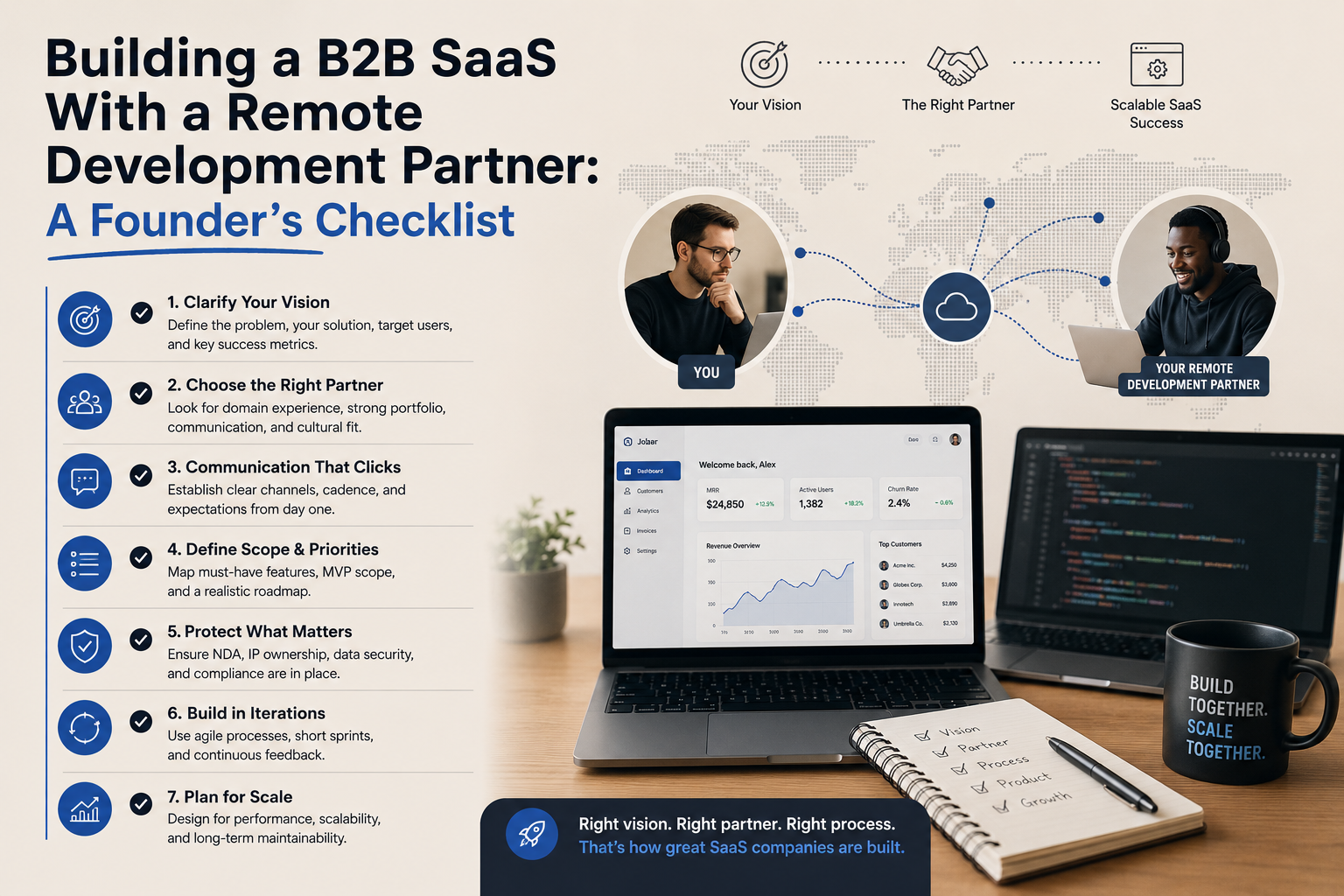
Building a B2B SaaS Product With a Remote Development Partner: A Founder's Checklist
Remote, Hybrid and On-site Teams
92% of SaaS startups fail within three years of launch, based on a comprehensive analysis of 483 startup post-mortems from CB Insights and Harvard Business Review research. Most founders who have read that statistic assume it is about product-market fit. Some of it is. But a significant portion of those failures trace to something more operational: the build itself was set up wrong from the beginning.
The pattern that repeats is this; a founder hires a remote development partner, skips the setup work that feels administrative, and eight weeks later is looking at a codebase they cannot own, an architecture that cannot scale to multiple clients, and a communication breakdown that has made every sprint a negotiation instead of a delivery.
Why B2B SaaS Is a Different Build
Before the checklist, this distinction matters. B2B SaaS is not a website with a login. It is a product that serves multiple business clients simultaneously, keeps their data isolated, bills them on a recurring basis, and has to meet enterprise security expectations before a procurement team will approve it.
Multi-tenant efficiency increases architectural risk. A single logic flaw can expose cross-tenant data. Strong tenant isolation, strict query filtering, and automated testing are critical in 2026 environments.
For years, many SaaS companies operated in a market where growth often mattered more than efficiency. In 2026, companies are being forced to balance both at the same time. Development cycles are shorter, but the architectural decisions made in week one carry further and break harder than they used to.
The specific requirements that separate B2B SaaS from a standard product build include multi-tenant data architecture, role-based access control, subscription billing logic, enterprise security posture, and compliance readiness — GDPR, SOC 2, HIPAA depending on the market you are entering.
None of these can be retrofitted cheaply. All of them need to be scoped, discussed, and decided before your remote partner writes the first line of production code. That is what this checklist is built around.
This checklist exists to prevent that. It is built specifically for B2B SaaS, a product category that carries architectural, legal, and commercial requirements that a standard web app build does not. Work through every section before your first sprint begins. The items that feel like overhead are the ones most likely to save you a complete rebuild at month four.
Section 1: Partner Evaluation Before You Sign
The most expensive mistake a founder makes is evaluating a remote development partner on price and portfolio alone. Both matter. Neither tells you whether the partner has built the specific type of product you are building.
Check 1: Verify SaaS-specific architecture experience
Ask for case studies of B2B SaaS products the partner has shipped, not web apps, not internal tools, not consumer products. Specialized SaaS MVP development services are essential for B2B products that require multi-tenancy, cloud security, and scalable infrastructure from day one.
The specific questions to ask:
- How have you handled multi-tenant data isolation in previous SaaS builds?
- What is your approach to role-based access control for a product serving multiple client organizations?
- Can you show me a system where you built subscription billing logic from scratch?
- What compliance requirements have you built to — GDPR, SOC 2, HIPAA?
A partner who cannot answer these specifically has not built B2B SaaS at the level you need. They have built web applications. Those are not the same thing.
Check 2: Assess communication structure, not just availability
70% of professionals report that communication challenges within their organization have led to wasted time. In a remote development context, that number compounds because the time wasted is not in a meeting, it is in a sprint cycle that produces the wrong thing and has to be rebuilt.
Before signing, establish:
- Who is your named point of contact on the partner's side: a delivery lead, a project manager, or an engineer who also manages their own work?
- What is the meeting cadence, daily standups, weekly sprint reviews, bi-weekly demos?
- Which tools are used for async communication and how quickly are responses expected?
- What is the escalation path when a decision needs to be made fast?
A partner who has no clear answer to the escalation question has never been tested by a real product decision under time pressure. That test is coming. Know the path before you are in it.
Check 3: Confirm IP ownership in the contract before anything else
This is the most legally consequential item on the checklist and the one most commonly left to later. Later means after the codebase exists and you have leverage.
Your first release must help target users complete one end-to-end workflow tied to the core problem. But before that release happens, the contract must clearly assign intellectual property ownership to you, as the client right from the first commit. Every line of code, every design asset, every API specification produced under the engagement must be assigned to you, not licensed to you, not retained as portfolio by the vendor.
Verify that the contract covers:
- Full IP assignment to the client on all work product
- No vendor right to reuse your architecture, design patterns, or codebase in other projects
- Source code ownership and access, so you can take the code if the engagement ends
- Confidentiality provisions covering your product concept, technical architecture, and business logic
If a partner pushes back on any of these, that is material information about how they operate.
Section 2: Product Definition —Before the First Sprint
The second most expensive mistake is starting to build before the product is defined with enough precision that the team can make decisions without you in every conversation.
Check 4: Complete a discovery sprint before any production code
Discovery is not a preliminary to the build. It is the foundation of the build. A proper discovery sprint produces the artefacts your remote team needs to make correct decisions without stopping to ask for direction every hour.
A discovery sprint for a B2B SaaS product should produce:
- A documented user journey for your primary user role; the workflow from first login to the completed action the product exists to enable
- A system architecture diagram showing how the components connect — frontend, backend, database, third-party integrations
- An API design document defining how the system's core components communicate
- A data model showing how tenant data is structured and isolated
- A sprint plan breaking the build into two-week cycles with defined deliverables for each
Compliance is non-negotiable in 2026. Identify the regulations affecting your MVP SaaS early, such as GDPR, HIPAA, or PCI DSS. Map these requirements to your product scope and user base. Early planning avoids costly rework after launch.
That compliance mapping belongs in the discovery sprint, not in the launch checklist.
Check 5: Define your one core workflow
Most SaaS MVPs need the same foundation: one core workflow, clear user onboarding, basic output visibility, product analytics, user feedback, and trust safeguards.
A B2B SaaS MVP that tries to ship five workflows ships none of them well. The discipline of committing to one core workflow, the single action your product exists to enable, end to end is the difference between a product that validates your thesis and a product that confuses your first ten customers.
Write it as a single sentence: "Our MVP allows [user role] to [complete action] without [the pain they currently have]." If your team cannot say it in one sentence, the scope is not clear enough to build against.
Check 6: Map your user roles and permission levels before architecture decisions
B2B SaaS products typically have multiple user roles, an account admin, one or more end users, and often a super-admin for your own team to manage client accounts. Each role has different permissions, different views, and different data access.
This sounds like a product decision. It is also an architecture decision. Role-based access control built into the system from the beginning is a different codebase than role-based access control bolted on after the product exists.
Document every user role your product will have at launch. For each role, define: what they can see, what they can do, what they cannot access, and what actions require an audit trail.
Give that document to your remote partner before architecture begins.
Section 3: Architecture — The Decisions That Cannot Be Undone Cheaply
This section is for founders who do not have a technical background. You do not need to understand the implementation. You need to understand what to ask for and what to confirm is in the plan.
Check 7: Confirm multi-tenancy is in the architecture from day one
Multi-tenancy is the ability to serve multiple client organizations on a shared infrastructure while keeping their data completely isolated. It is the architectural foundation of every B2B SaaS product. It is also the thing most commonly skipped in early builds and added later at enormous cost.
Ask your partner directly: how are you implementing multi-tenancy? The two common approaches are database-per-tenant (a separate database for each client — more secure, higher infrastructure cost) and shared-database-with-row-level-isolation (all clients in the same database with strict query filtering to prevent data crossover — lower cost, higher architectural precision required).
Either approach can be correct depending on your market and your compliance requirements. What is not acceptable is no approach or the assumption that you will figure it out after you have customers.
Check 8: Confirm security architecture meets enterprise buyer expectations
If you are selling B2B SaaS, customers will ask for compliance documentation. The absolute minimum standard for 2026 includes: MFA enforced for all internal developer accounts, all cloud storage set to private by default, and CloudTrail or equivalent enabled for cloud provider audit logs.
Enterprise procurement teams — the buyers your B2B product will need to pass now run security reviews as a standard step before signing. A product that cannot provide basic documentation of its security architecture will not pass those reviews regardless of how well the product works.
The minimum architecture to confirm before build begins:
- Encryption at rest and in transit for all data
- MFA enforced across all internal systems
- Role-based access control at the application layer
- Audit logging for all actions taken by all user roles
- Environment separation; development, staging, and production are completely isolated
- Secrets management — API keys and credentials are not stored in the codebase
According to A-lign's 2025 Compliance Survey, B2B software companies now view SOC 2 as essential for competitive positioning, not just a customer checkbox. If your target market includes US enterprise clients, SOC 2 readiness needs to be in the architecture plan from the beginning not a project you start after your first enterprise lead asks for it.
Section 4: Communication and Delivery — During the Build
Check 10: Establish a two-week sprint cadence with a working demo at every cycle end
The sprint structure is not a process preference. It is the mechanism that prevents your remote build from drifting. A two-week sprint with a working demo at the end means you see functional software every two weeks — not a status update, not a percentage complete figure, but something you can open in a browser and interact with.
If a demo cannot be produced at the end of a sprint, the sprint is not scoped correctly. The deliverable for each sprint should be a working slice of the product, not a component that will be part of something working later.
This single practice eliminates the most common failure mode of remote builds: six weeks of work that does not integrate, discovered in week seven.
Check 11: Assign a product owner with decision authority
In 2026, SaaS founders will find themselves in a fierce battle for top talent. High turnover, especially in critical roles, can set a SaaS company back significantly, impacting its ability to scale and innovate.
The less discussed version of that problem is internal: a remote team that cannot get product decisions made quickly stalls. The root cause is almost always that no one on the client side has the authority and the availability to answer questions and make calls within 24 hours.
Name a product owner. This is the person who can answer: should this feature work this way or that way, what is the priority when two things conflict, is this done or does it need a change. That person needs to be reachable within one business day. If decisions queue for a week, sprints slip — and slipping sprints in a funded startup are not just a schedule problem, they are a runway problem.
Check 12: Create a shared definition of done
"Done" is one of the most argued words in software development. Done from an engineer's perspective often means the code works in the development environment. Done from a founder's perspective usually means it works for users.
Write a shared definition before the first sprint begins. For a B2B SaaS product, "done" for a feature typically means:
- The feature works correctly for all user roles it applies to
- It has been tested in the staging environment against real-world data
- Edge cases have been identified and either handled or explicitly deferred
- The code is reviewed, merged, and documented
- It is deployed to staging and the product owner has signed off
Add acceptance criteria to every ticket. A ticket without acceptance criteria is a scope argument waiting to happen.
Section 5: Launch Readiness — Before You Go Live
Check 13: Run a security audit before your first enterprise demo
Not after you close the deal. Before the first demo that a real enterprise buyer will see because after that demo, the next step is often a security review, and the gap between "we will deal with security before launch" and "an enterprise client is waiting for our SOC 2 documentation" is shorter than most founders expect.
Ensure the testing firm uses a blend of automated scanning and manual exploitation, since logic flaws cannot be found by scanners. Demand a prioritized remediation report, not just a raw PDF export from Nessus.
A pre-launch penetration test for a lean B2B SaaS MVP typically costs $3,000–$8,000 and takes one to two weeks. It is one of the highest-leverage items in the launch budget.
Check 14: Confirm your analytics and feedback infrastructure is live at launch
A B2B SaaS product that launches without product analytics is a product you cannot learn from. The data you need from your first users, where they drop off, what they complete, what they ignore — is gone if the instrumentation was not in place when they arrived.
At minimum, confirm before launch:
- Product analytics — events tracked for every core action in the primary workflow
- Error monitoring — every server-side error captured, categorized, and alerted
- Uptime monitoring — independent monitoring of the product's availability with alerting to your team
- A feedback mechanism — something simple that allows your first users to report problems or ask questions without emailing you personally
The data from your first 30 users is more valuable than the data from your first 3,000, because it is the data that decides what you build next. Do not lose it.
Check 15: Document the handover and ongoing development plan before launch
What happens after launch? Who maintains the codebase? Who handles the bug that appears at 11pm on a Friday? Who builds the features that your first users ask for?
If the answer is unclear, you have a product with no owner after it goes live which is a common and expensive outcome of remote builds that were scoped as projects rather than as product partnerships.
The handover document should specify:
- Where the codebase lives and who has access
- How the infrastructure is managed and what the access credentials process is
- What ongoing development looks like — the team, the cadence, the cost
- How support and incident response will work post-launch
At Tribesquare, we structure this conversation at the start of every engagement, not at the end. The post-launch plan shapes the architecture of the build. A product that will be maintained by the same team that built it is built differently and better than a product handed over to an unknown successor.
Check 9: Define your infrastructure and deployment model upfront
Where is the product hosted, how is it deployed, and who manages it? These are not details to decide later. They affect cost, security posture, latency for your users, and your ability to meet data residency requirements if you have clients in regulated markets.
Confirm with your partner:
- Cloud provider — AWS, GCP, Azure — and the rationale for the choice given your user geography
- CI/CD pipeline — how code moves from development to production, with what checks, and how rollbacks are handled
- Monitoring and alerting — what gets measured, what triggers an alert, and who responds
- Backup and recovery — how data is backed up, how often, and what the recovery time objective is
A remote partner who cannot specify these at the architecture stage has not scoped the operational side of the build. You will discover that gap at 2am when your product is down and your first enterprise client is waiting.
The Full Checklist at a Glance
Partner evaluation
- Verify B2B SaaS-specific architecture experience — multi-tenancy, RBAC, billing logic
- Assess communication structure — named contacts, cadence, escalation path
- Confirm IP assignment in the contract before engagement begins
Product definition
- Complete a discovery sprint before any production code is written
- Define one core workflow the MVP will enable, end to end
- Map all user roles and permission levels before architecture decisions
Architecture
- Confirm multi-tenancy approach is designed in from day one
- Confirm security architecture meets enterprise buyer expectations
- Define infrastructure, deployment model, and monitoring upfront
Communication and delivery
- Two-week sprints with a working demo at every cycle end
- A named product owner with decision authority on the client side
- A shared written definition of done attached to every ticket
Launch readiness
- Security audit completed before the first enterprise demo.
- Product analytics, error monitoring, and feedback infrastructure live at launch.
- Handover and ongoing development plan documented before go-live.
How the Engagement Model Affects Every Item on This List
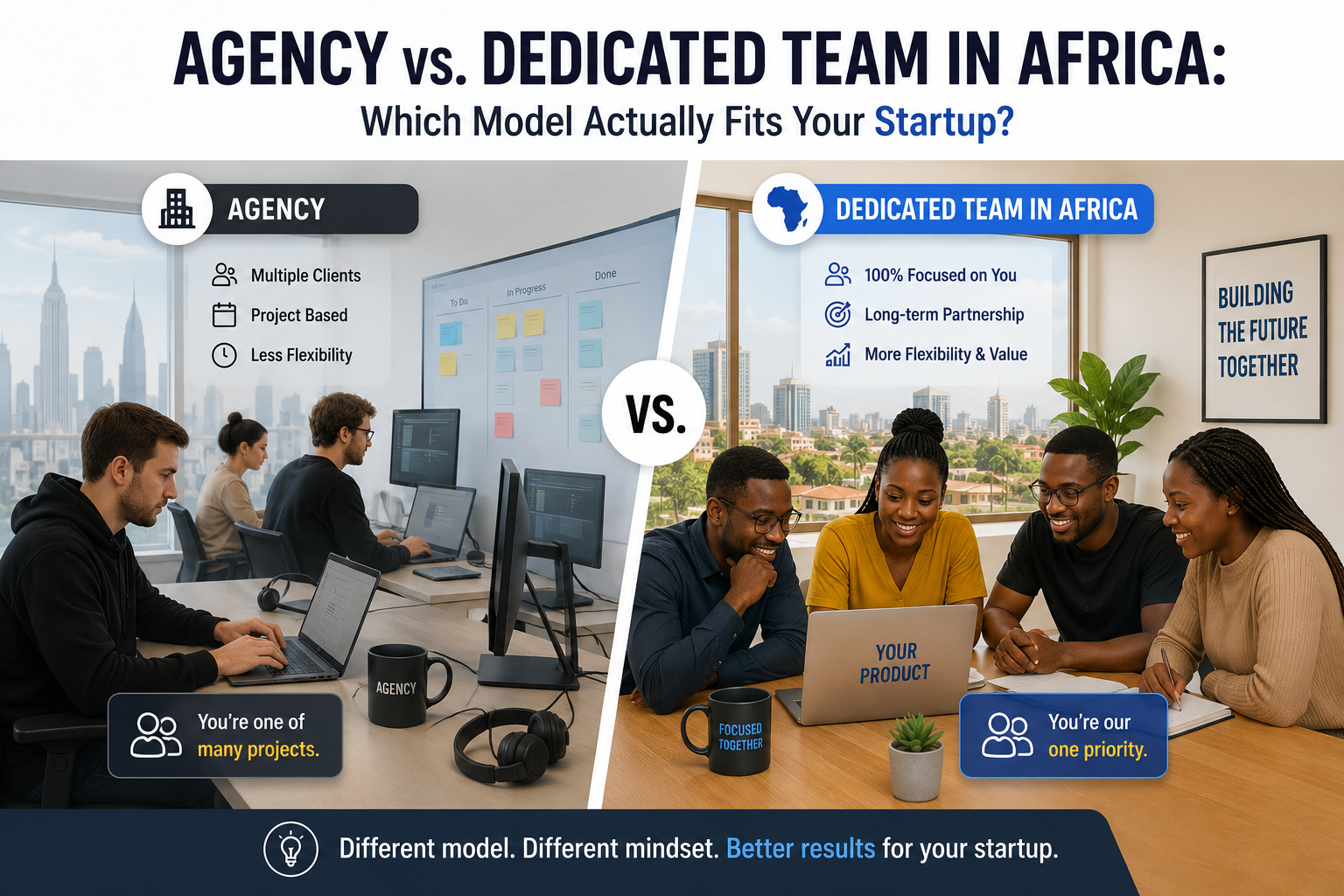
This checklist changes in difficulty depending on the engagement model you are using. A pure agency where you define a scope and the vendor delivers it makes most of these items harder, because you are interacting with a project manager, not with the engineers making the decisions.
A dedicated team or a product development partner, where the same engineers are embedded in your process for the duration of the build and beyond makes these items easier, because the communication structures, the sprint cadences, and the product ownership questions are part of the engagement design from the start.
For a detailed comparison of those models and a decision framework based on your startup stage, read: Agency vs. Dedicated Team in Africa: Which Model Fits Your Startup.
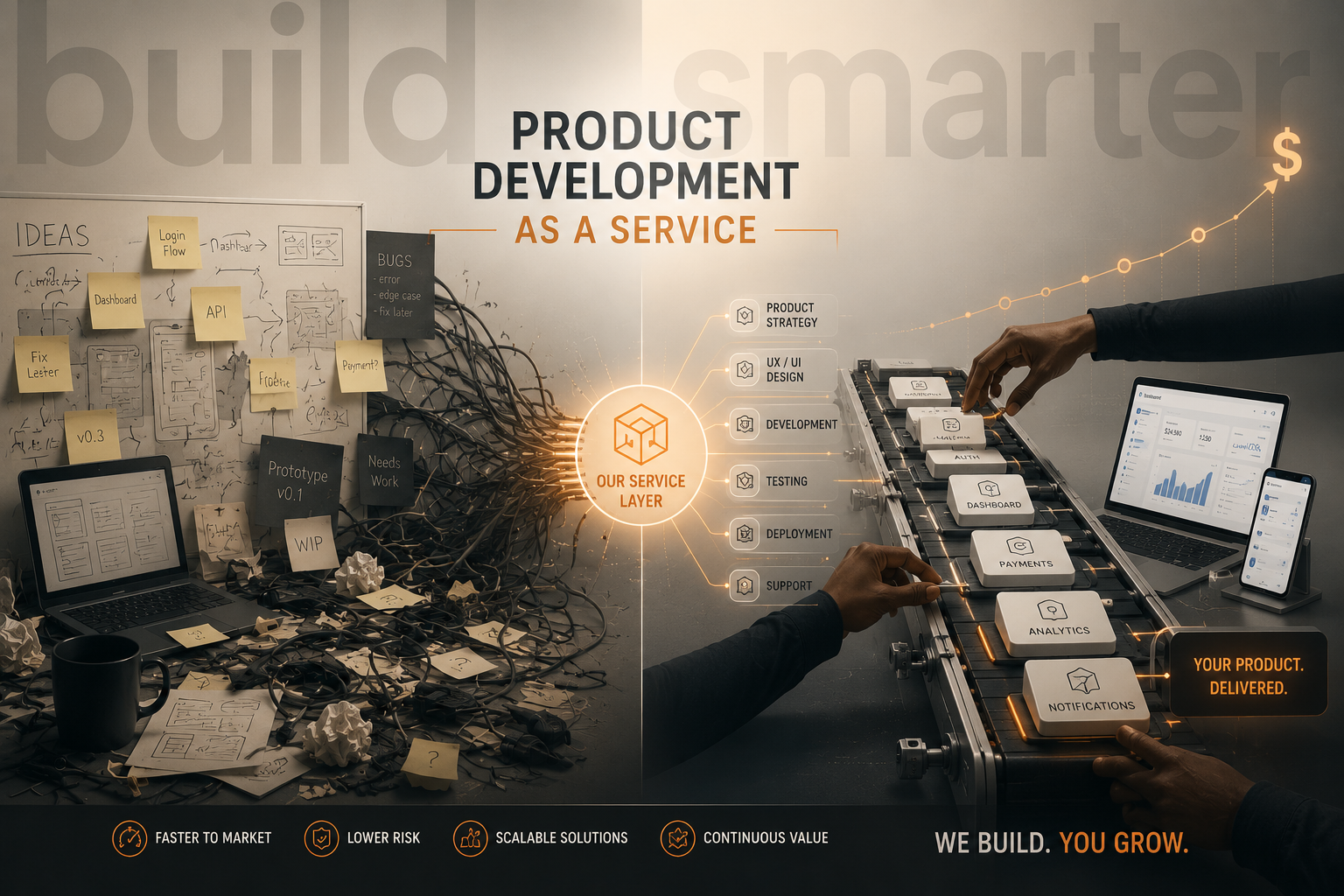
If you are building a B2B SaaS product and do not yet have technical leadership who can manage the engineering execution, Product Development as a Service is the model that covers the delivery management your team does not have in-house while keeping you in control of the product direction.
What Tribesquare Brings to a B2B SaaS Build
Tribesquare's engineering teams have shipped B2B SaaS products across fintech, retail, and enterprise software products with real multi-tenant architecture, real compliance requirements, and real enterprise clients applying real scrutiny to their security posture.
FoodOnline went from brief to working MVP in four weeks, then to a full v1 serving five thousand customers and vendors across twenty Nigerian cities at above 99% uptime. Justrite's crash rate dropped from 40% to under 1% in ten weeks, with ERP sync latency reduced from three to five minutes down to under five seconds. GetPayed onboarded ten professionals at an average of two weeks each, with a 90% retention rate across the embedded team.
Every engagement starts with the discovery sprint. Every sprint ends with a working demo. Every client owns their codebase from the first commit.
Talk to Us
If you are building a B2B SaaS product and want to understand what a Tribesquare engagement looks like for your specific product, the team configuration, the architecture approach, the timeline, and the economics, book a discovery call. We will work through this checklist with you, identify the gaps, and tell you plainly whether we are the right partner for the build.