Agency vs. Dedicated Team in Africa: Which Model Actually Fits Your Startup
Engineering Teams
Most articles on this topic answer a question nobody asked. They compare outsourcing models as if the answer is universal or as if a pre-seed founder validating their first hypothesis has the same engineering needs as a Series B CTO scaling a platform serving 500,000 users.
They don't.
The right model depends almost entirely on where you are in your build, what you're protecting, and how fast the ground under you is moving. Get it wrong and you don't just waste money, you wire the wrong incentives into your engineering culture at the moment it's being formed.
This is the framework we use at Tribesquare to help founders make that call clearly.
Why This Decision Matters More When You're Building in Africa
Africa's developer ecosystem has grown 21% annually between 2019 and 2024 faster than any other continent, according to a 2026 BCG report. Nigeria, South Africa, and Egypt each now have developer communities exceeding 500,000. Four in every ten African software developers are now employed by companies based outside the continent. The talent is here, documented, and increasingly proven at a global standard.
That changes the calculus. When you're hiring in Eastern Europe or Latin America, the agency vs. dedicated team decision is mostly about process and control. When you're building with African talent, the decision also affects how much of that talent you actually own, develop, and retain and that is a strategic question, not just an operational one.
Africa's tech workforce is young, digitally native, and motivated. It is also in demand. The engineers who go deep on your codebase, your architecture, your domain will be recruited. The question is whether your engagement model gives you the continuity to protect that investment or leaves you rebuilding context every six months.
That's the lens through which this comparison should be read.
The Two Models, Defined Without Marketing Language
What a development agency actually is
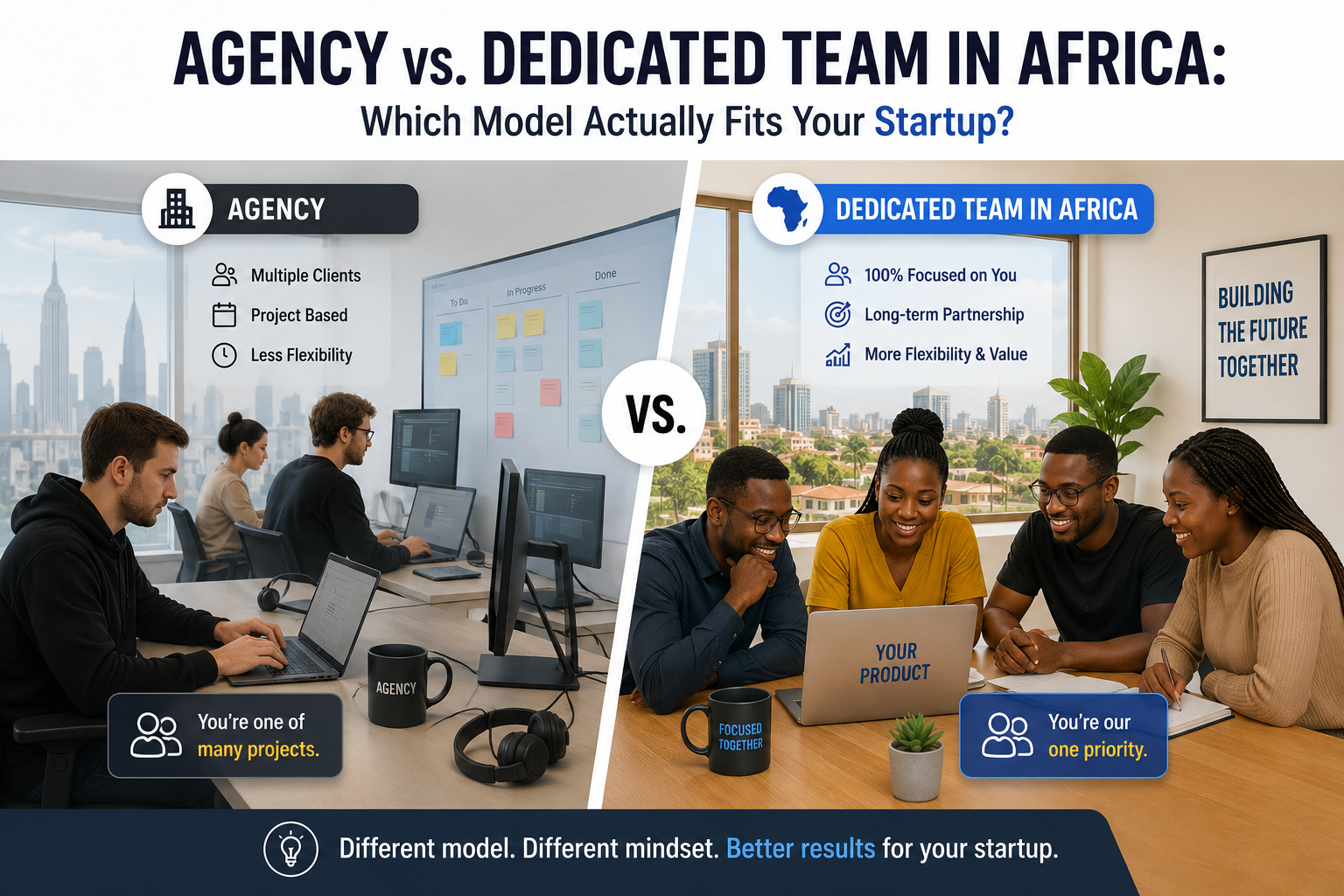
An agency takes a scoped project and delivers it. You define the output — an MVP, a feature set, a platform and the agency manages the build internally. You interact with a project manager or account lead. The engineers underneath may change. You don't choose them, you don't manage them, and you often don't know who they are.
The model optimises for delivery of a defined thing. It does not optimise for continuity, deep product knowledge, or flexibility when the spec changes which in most startups, it does.
What agencies are genuinely good for:
- Discrete, well-scoped projects where the requirements are stable
- Situations where you have no internal technical leadership and need a team to self-manage
- MVP builds where speed matters more than architectural ownership
- Short-term capacity for one-off infrastructure or migration work
Where agencies break down:
- When requirements shift mid-project (agencies charge for scope changes; those charges compound quickly)
- When you need daily visibility into technical decisions
- When the product is your core IP and you plan to own it long-term
- When the relationship between engineers and your product context is a competitive asset
What a dedicated engineering team actually is
A dedicated team is a group of vetted engineers who work exclusively on your product, embedded into your sprint cycles, your tools, your standups, and your codebase. You interview them. You choose them. You manage direction. The Tribesquare's model — handles sourcing, vetting, compliance, and operational continuity.
The model optimises for product depth, team continuity, and output velocity over time. It is not project outsourcing. It is a team extension with the economics and flexibility that in-house hiring cannot match at startup speed.
What dedicated teams are genuinely good for:
- Products that require ongoing development, iteration, and maintenance
- Situations where you have a technical lead who can direct work
- Scaling an existing team without the 90-day hiring delays of full-time recruitment
- Building codebase ownership and institutional knowledge that compounds over time
Where dedicated teams require realistic expectations:
- You need internal technical leadership or a strong delivery framework the team augments your direction, it does not replace it
- Onboarding takes two to four weeks before full velocity is reached
- The model is a commitment, not a tap you switch on for a sprint and off the next month
The Decision Framework: Four Questions That Settle It
1. Can you write a spec that will not change in the next 30 days?
This is the most diagnostic question. If the answer is yes — your requirements are clear, your architecture is decided, the acceptance criteria are defined, an agency can execute. The agency model works when there is a stable target.
If the answer is no — and in most startups building real products, it is no, an agency becomes expensive the moment the ground shifts. Every pivot, every product discovery insight, every integration change becomes a scope negotiation. You pay for the original spec and then you pay again for the deviation from it.
A dedicated team absorbs that movement because they are inside your process. The same engineers who built the original feature adapt it. There is no renegotiation. There is just the sprint.
Agency if: Stable, well-defined scope. You know exactly what you are building.
Dedicated team if: The product is still evolving. Discovery and delivery are happening simultaneously.
2. Do you have internal technical leadership?
This is where founders underestimate the dedicated team model. A dedicated team does not replace a CTO or a lead engineer it extends one. If you have no one internally who can define tickets, review architecture decisions, and manage engineering direction, you need a partner who can handle delivery management, not just talent.
Tribesquare's model accounts for this. For companies without internal technical leadership, we embed delivery leads as part of the engagement. But the distinction matters: a dedicated team at its most powerful is working under your direction with your strategy. When that direction is absent, you have recreated the conditions of an agency engagement but without the agency's project management infrastructure.
Agency if: No internal technical lead. You need someone to manage the build end to end.
Dedicated team if: You have a CTO, VP of Engineering, or a strong lead who can direct engineers daily.
3. Is your product your core IP, or is it a support system?
There is a meaningful difference between building software that is your business and building software that supports your business. A fintech startup whose product is a payment infrastructure is in a fundamentally different position than a logistics company that needs a driver management app to complement its operations.
If the software is the business — the thing you will raise on, the thing you will be acquired for, the thing that has to scale and evolve for years; you need architectural ownership from day one. That ownership lives in engineers who know the codebase deeply over time. An agency delivers a version of the product; a dedicated team builds your product.
If the software supports the business but is not the primary competitive asset, an agency can deliver a reliable, scoped build faster and more cleanly.
Agency if: The software is a tool, not your product. Fixed scope, defined ROI, no ongoing evolution required.
Dedicated team if: The software is the product. You will be evolving it for years and need engineers who grow with it.
4. What stage is your startup?
Stage is a proxy for all of the above, and it is the fastest way to orient the decision.
Startup Stage: Pre-PMF (idea to first users), Post-PMF, pre-Series A, Series A, Series B and beyond.
Recommended Model: Agency or 1–2 senior augmented engineers, Dedicated team (small, senior), Dedicated team (scaling), Hybrid: dedicated team + selective in-house.
Rationale: Validate fast. Don't build a team around a hypothesis, You know what you're building. Speed and continuity now compound, Engineering velocity is a fundraising input. Dedicated teams deliver it without 6-month hiring timelines, Core IP stays in-house. Dedicated team scales capacity.
The Cost Reality in 2026
The conversation about cost when hiring in Africa is frequently framed wrong. "Africa is cheaper" is true and also almost entirely beside the point for a founder evaluating a multi-month engineering commitment.
The real cost question is total cost of outcome not line-item rate.
A development agency in Africa charging $40–80 per hour for a 600-hour MVP build looks like $24,000–$48,000 on paper. Add scope changes (typical in a real product build: 20–40% overage), a weak handover with undocumented architecture, and a second engagement to fix the integration issues and that MVP costs twice what the quote said.
A dedicated team at Tribesquare, embedded in your process from week one, building toward your architectural standards, with documented code and a delivery lead who owns continuity delivers a product you can build on. That is the economics that matters.
For context on the broader market: dedicated remote engineering teams in 2026 run approximately $8,000–$12,000 per engineer per month depending on seniority and stack, with African talent sitting at the lower end of that range for equivalent output quality. By comparison, the fully loaded cost of a senior in-house hire in North America or Western Europe : salary, benefits, equipment, management overhead runs $180,000–$300,000 annually. The savings are real. Tribesquare clients typically realize 20–30% savings compared to equivalent Western hiring, reinvested directly into runway and growth.
The decision is not: agency is cheap, dedicated team is expensive. The decision is: which model produces the outcome I need at this stage, with this scope, under these constraints?
What the Africa Context Changes About This Decision
Two things are specific to building with African talent that do not apply the same way to other outsourcing geographies.
Talent retention is a strategic asset, not a given. Africa's developer community is growing at 21% annually. Demand from global companies is accelerating. 40% of African developers are already employed by companies outside the continent. Engineers with deep product context and strong delivery track records are being recruited actively. An agency model, where you never form direct relationships with the engineers building your product, leaves you with zero continuity leverage. A dedicated team model, where the same engineers work on your product for months, builds retention incentives on both sides. Tribesquare's retention rate across embedded teams is not an accident, it is the structural outcome of a model built around continuity.
Time-zone alignment is an actual advantage, not a talking point. African teams working with European founders have genuine real-time overlap — typically 4–6 hours of synchronous time with Western European time zones, and partial overlap with US East Coast. That means daily standups are real standups. Architecture decisions get made in real time, not over async threads. This advantage is wasted on a pure agency model where your interaction is with a project manager whereas it compounds in a dedicated team model where your engineers are in your Slack, your Linear, your calls.
The Decision, Stated Plainly
Choose an agency if:
- You have a stable, well-scoped project with defined acceptance criteria
- You have no internal technical leadership and need end-to-end delivery management
- The software is a one-time build, not an evolving product
- You are pre-PMF and validating whether to build at all
Choose a dedicated team if:
- Your product is your core IP and it will evolve for years
- You have a CTO or technical lead who can direct engineers
- You are post-PMF and engineering velocity now directly affects growth
- You need to scale fast without 90-day hiring timelines and the full cost of in-house employment
Most founders reading this are in the second category. They know what they are building. They have raised enough to build it seriously. They cannot afford the cost of a project handover that leaves them rebuilding context — or an agency engagement that becomes a negotiation every time the product learns something.
Tribesquare builds dedicated engineering teams with Africa's best engineers vetted against your stack, embedded in your process, and accountable for outcomes. FoodOnline's MVP went live in eight weeks. Justrite's crash rate went from 40% to under 1% in ten weeks.
The model works when it is the right model for the stage.
Talk to Us
If you are still deciding or if you know you need to build and want to understand what a dedicated team engagement looks like in practice, book a discovery call with our team. We will ask you the four questions above, understand your stack and your timeline, and tell you plainly whether Tribesquare is the right fit. If it is not, we will tell you that too.