Product Development as a Service: What It Is, What It Costs, and When to Use It
Software Engineering
The term gets used loosely. Some vendors call it PDaaS when they mean a project-based agency engagement. Others use it to describe staff augmentation with a fancier slide deck. The confusion is expensive not because the label matters, but because founders make hiring decisions based on a misunderstanding of what they are actually buying.
PDaaS is a specific model. It has a specific structure, specific economics, and a specific profile of startup it serves well. Get those right, and it is one of the most capital-efficient paths to a working product. Get them wrong, and you are paying premium rates for something that is not built for your stage.
This article defines the model precisely, names the real costs in 2026, and gives you the framework to decide whether it fits what you are building.
What Product Development as a Service Actually Is
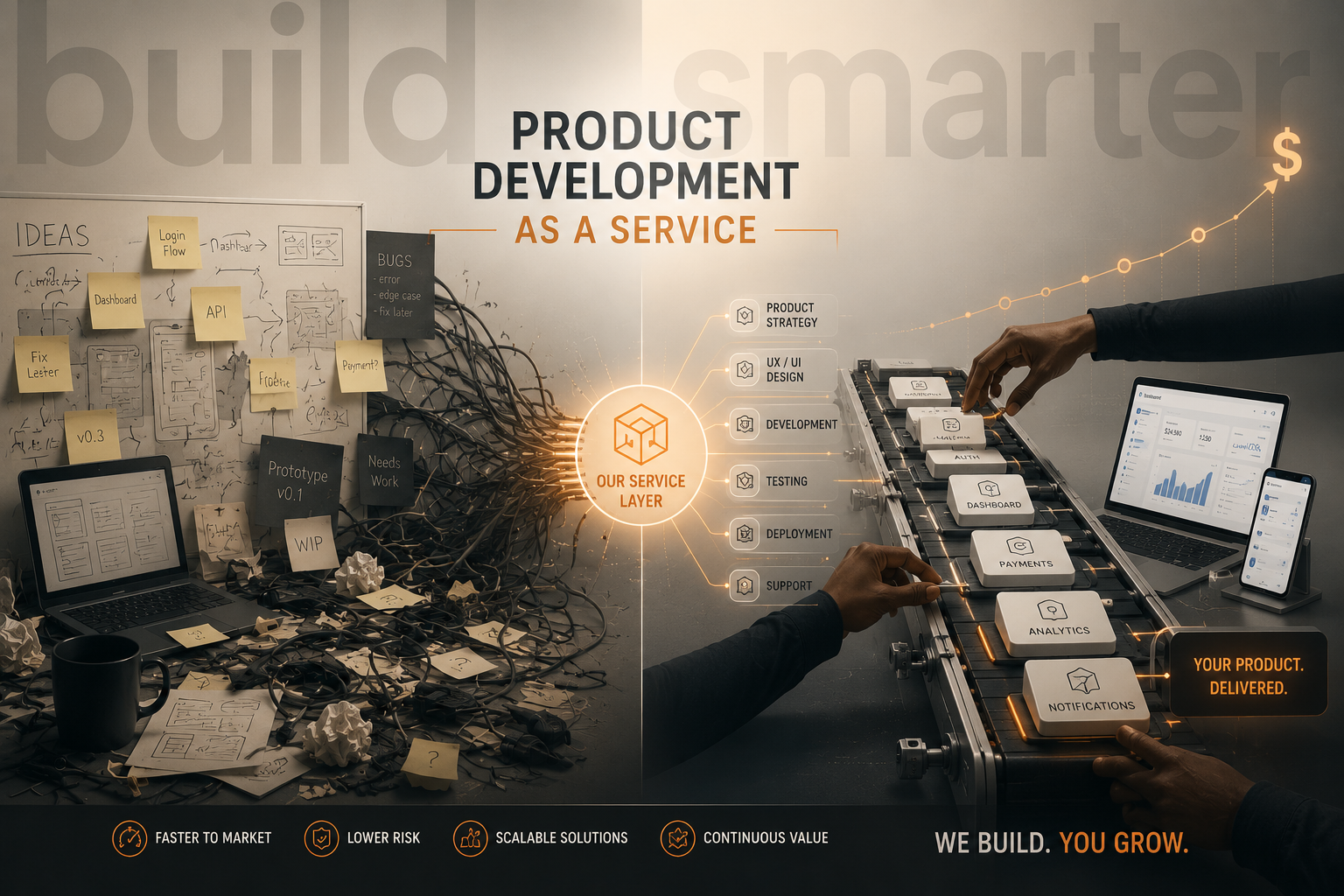
PDaaS is an engagement model in which an external partner takes responsibility for the full lifecycle of building your software product from discovery and architecture through development, QA, and deployment while you retain strategic ownership of the product direction.
The distinction that matters: PDaaS is not outsourcing a task. It is outsourcing a capability.
In a typical agency engagement, you define a scope and the vendor delivers it. In staff augmentation, you add engineers to your existing team who execute under your direction. In PDaaS, you bring in a partner who can think, build, and deliver end to end covering the functions you do not have in-house, without requiring you to build an engineering organisation from scratch to get there.
A PDaaS engagement typically covers:
- Discovery and scoping — translating a product idea into an architecture, a roadmap, and a delivery plan
- UX/UI design — user flows, wireframes, and interface design built for the actual users, not for a portfolio
- Full-stack engineering — frontend, backend, APIs, integrations, and infrastructure
- Quality assurance — automated and manual testing built into the delivery cycle, not bolted on at the end
- Deployment and DevOps — CI/CD pipelines, hosting configuration, and monitoring from day one
- Post-launch iteration — product refinement based on real user data, not assumptions
What PDaaS does not cover: your product strategy, your commercial positioning, your user research. Those stay with you. A PDaaS partner builds the product you have defined and evolves it as you learn. It is not a co-founder. It is not a strategy consultant. It builds.
The 2024 Deloitte Global Outsourcing Survey found that access to talent and capability has now overtaken cost reduction as the primary reason companies outsource — cited at nearly twice the rate of pure cost savings. PDaaS is the structure that delivers on that intent: capability access, not just resource access.
How PDaaS Differs From an Agency or a Dedicated Team
The three models are frequently conflated. They are not the same thing, and the differences are consequential.
Agency / Project Outsourcing
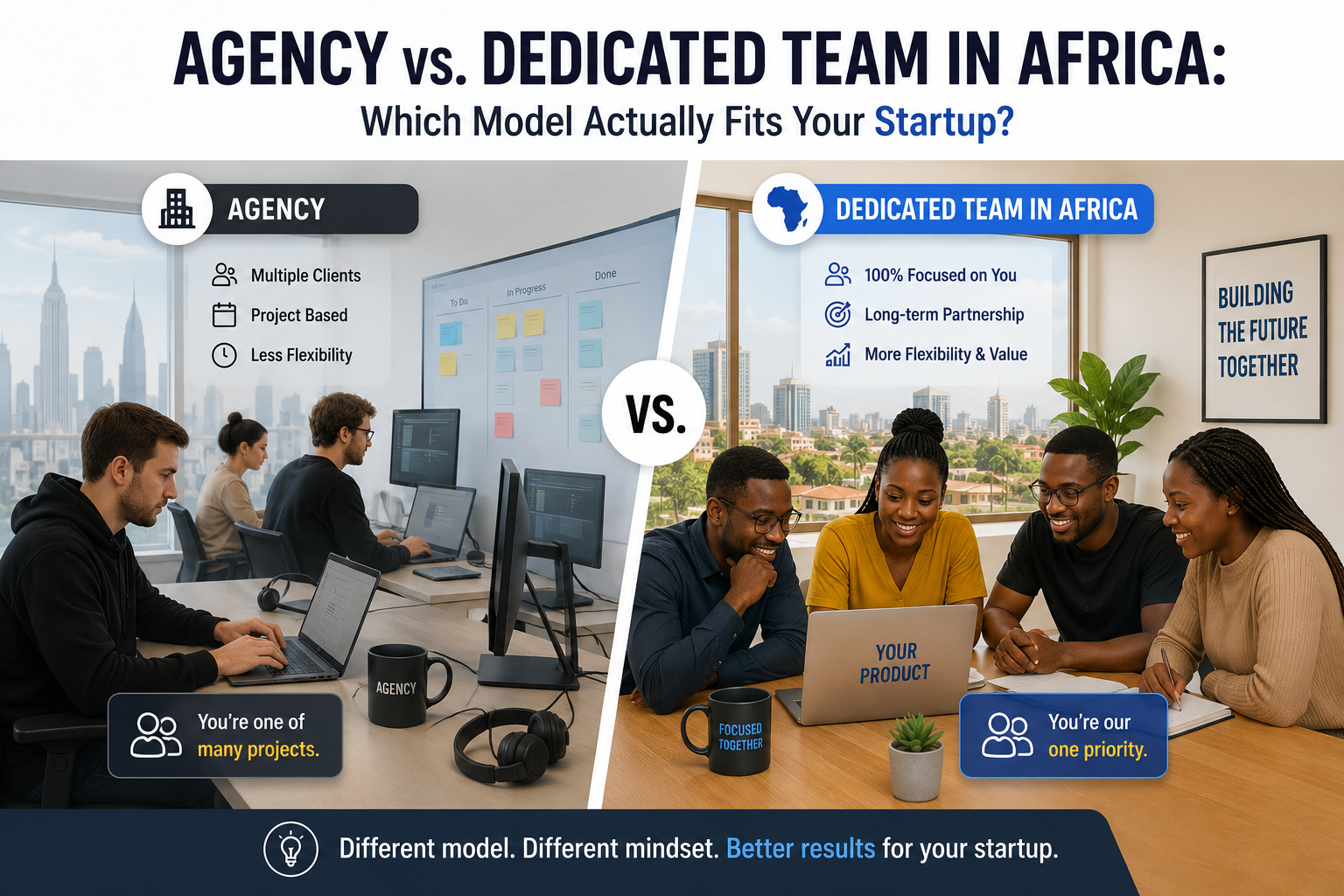
You define a fixed scope upfront; the agency delivers it and hands it over. Spec flexibility is low and every change is a contract negotiation. The agency manages the build internally, so you do not need technical leadership on your side. IP ownership is contractual and worth verifying carefully. When the project ends, so does the relationship. Best for discrete, stable projects with requirements that will not move.
PDaaS
The partner takes the full lifecycle: discovery, build, QA, deployment, and iteration while you retain strategic direction. Scope evolves as the product learns. You need partial product ownership on your side (someone to make product decisions) but not a CTO to manage engineers. IP is client-owned from day one. The partner grows with the product. Best for end-to-end product builds where speed and continuity both matter.
Dedicated Team
Engineers embed into your process and execute under your direct management. Spec flexibility is high, you control it. Technical leadership on your side is required; the team augments your direction, it does not replace it. IP stays with you. The team remains embedded as long as the engagement runs. Best for scaling an existing product and engineering team without the overhead of full-time hiring.
The clearest way to distinguish PDaaS from a dedicated team: a dedicated team executes under your direction. A PDaaS partner brings the direction capability with them. If you have a CTO managing a sprint cycle, you want dedicated engineers. If you are a non-technical founder who needs someone to own how the product gets built while you own what it does that is PDaaS.
For a deeper comparison of the dedicated team model versus agency outsourcing, and a decision framework based on startup stage, read our full breakdown: Agency vs. Dedicated Team in Africa: Which Model Fits Your Startup.
What PDaaS Costs in 2026: Real Numbers
Most articles on this topic describe cost ranges so wide they are useless. "PDaaS costs between $10,000 and $500,000" is technically accurate and practically worthless.
The cost of a PDaaS engagement depends on three variables: scope, team configuration, and geography. Here is how those play out at each stage of a typical product build.
Stage 1: Discovery and architecture (2–4 weeks)
This is the phase most founders skip and the one most responsible for expensive rework later. A proper discovery covers user stories, system architecture, API design, and a sprint plan for the build.
Typical cost: $3,000–$8,000
Skipping this does not save money. Research from outsourcing practitioners consistently shows that discovery costs 5–10% of the total project budget but prevents most common failure modes like scope creep, integration surprises, and architectural decisions that cannot be undone cheaply.
Stage 2: MVP build (6–12 weeks)
The MVP is the first deployable version of the product, not a prototype, not a full-featured platform. The scope is the minimum set of features that allows real users to do the core thing the product exists to do.
Typical cost range in 2026:
- Lean MVP (web or mobile, single core workflow): $15,000–$40,000
- Standard MVP (multi-feature, basic integrations): $35,000–$70,000
- Full v1 (complex integrations, payment processing, admin layer): $60,000–$120,000+
SaaS startup costs in 2026 typically break down across build, infrastructure, third-party services, and post-launch iteration — with year-one total cost for a bootstrapped founder landing between $120,000 and $350,000 depending on scope and team location.
African engineering partners sit at the lower end of global cost bands while delivering at global quality standards. Tribesquare's engagements deliver MVP builds at 20–30% lower cost than equivalent North American or Western European teams — savings that go directly back into a founder's runway.
Stage 3: Ongoing development and iteration (monthly)
After launch, real users produce real data. That data drives product changes. Most founders underestimate the cost and importance of this phase — building an MVP is only half the job.
Typical monthly cost for ongoing PDaaS:
- Small team (2 engineers + PM): $8,000–$14,000/month
- Mid-size team (3–4 engineers + design + QA): $16,000–$28,000/month
These figures assume Africa-based talent. Equivalent team configurations in Eastern Europe run $20,000–$40,000/month; North America or Western Europe, $40,000–$80,000/month or more.
The cost of getting it wrong
The global software development outsourcing market is valued at USD $564 billion in 2025, growing at 9.6% annually according to Mordor Intelligence. Between 50–70% of outsourced software projects miss deadlines, exceed budgets, or require expensive rewrites. The Dun & Bradstreet Barometer of Global Outsourcing found that 20–25% of outsourcing relationships fail within two years, and half fail within five.
The pattern is consistent: failure is almost never about bad code. It is about misaligned incentives, undefined success criteria, and the wrong model chosen for the stage.
PDaaS, chosen correctly and structured well, removes most of those failure conditions by design.
When PDaaS Is the Right Model: Three Signals
Signal 1: You are building a real product, not validating a hypothesis
PDaaS is not the right model for a founder who is still asking whether the problem exists. If you are pre-PMF and genuinely unsure whether users want what you are building, the right move is a lean agency engagement, build something fast, test it, learn from it.
PDaaS is the right model when you have validated the problem and are now building the product that solves it. You have enough directional clarity to warrant a full build, but you do not have or do not want to build it, hire an internal engineering organisation to execute it.
Signal 2: You can own the product direction, but not the engineering execution
PDaaS requires a client-side owner who can make product decisions: what to build next, what the user needs, what success looks like. It does not require a client-side CTO or engineering lead. The partner provides that function.
If you have a founder or product lead who understands the user deeply and can drive priorities but no one who can run a sprint, manage engineering tradeoffs, or architect a system, PDaaS closes that gap. You bring the product intelligence. The partner brings the engineering leadership.
If you already have a strong CTO who wants to manage the build directly, a dedicated team model is a better fit. Your lead directs; the team executes.
Signal 3: You need a working product faster than hiring allows
The average time-to-hire for a senior engineer in Western Europe or North America in 2026 runs 6–11 weeks — before onboarding, before they have context on your codebase, before they are producing at full velocity. Building a team of five in-house takes six months minimum from first job post to first commit at full capacity.
PDaaS starts in days. The team exists. The process exists. The first sprint begins within two weeks of engagement start.
For a funded startup between pre-seed and Series A, where every month of runway has a direct value and time-to-market is a competitive variable, that speed is worth the premium over cheap, slow, or uncertain alternatives.
What Makes PDaaS Work: The Non-Negotiables
PDaaS fails predictably when two conditions are absent. Both are client-side responsibilities.
A genuine product owner. The partner builds what you define. If no one is making product decisions with authority and clarity that is if the feedback cycle is slow, the priorities keep shifting, or there is no single voice on what the product should do, the engineering team cannot operate at velocity. The PDaaS model amplifies your product clarity. It cannot substitute for the absence of it.
Defined success criteria upfront. Keyhole Software's analysis of 2026 outsourcing data found that approximately 55% of organisations begin external engagements without defined success metrics — and that this single gap is the operational cause of most disputed outcomes. Before any code is written, the engagement needs to define what a successful MVP looks like, what the acceptance criteria are for each feature, and what the handover or ongoing structure looks like after launch.
These are not complex requirements. They take a week to get right at the start of an engagement. They save months at the back end.
Tribesquare's PDaaS Model: How It Works
Tribesquare operates a PDaaS model built for global founders who need Africa's engineering talent deployed at global standards — with a delivery structure that does not require the client to manage it.
The engagement follows four phases:
1. Discovery (1–2 weeks) We review your product brief, map the user journey, define the architecture, identify integration dependencies, and produce a sprint plan. You review and approve before a single line of code is written.
2. Build (6–16 weeks depending on scope) Your dedicated squad — typically a lead engineer, two to three engineers, a designer, and a QA lead builds in two-week sprints with a demo at the end of every sprint. You see working software every two weeks, not a finished product six months later.
3. Launch and handover We deploy, document, and configure monitoring. If you are scaling to a dedicated team model for ongoing development, we structure the handover so there is no loss of context. FoodOnline went from brief to MVP in eight weeks, then to full v1 on schedule, serving five thousand customers and vendors across twenty Nigerian cities at above 99% uptime.
4. Ongoing iteration (optional) Post-launch development continues under the same team. Justrite's initial engagement to fix a 40% crash rate and rebuild ERP integrations took ten weeks. Crash rate dropped to under 1%. Sync latency went from three to five minutes down to under five seconds. The same team continued on product development work after that.
The Africa Advantage in a PDaaS Context
Africa's developer base grew 21% annually between 2019 and 2024 — the fastest growth rate of any continent globally, according to a 2026 BCG report. Nigeria, South Africa, and Egypt each have developer communities exceeding 500,000. Forty percent of African developers are now employed by companies based outside the continent.
In a PDaaS context, the Africa advantage operates on three dimensions:
Economics. Tribesquare clients realise 20–30% savings compared to equivalent North American or Western European teams. For a startup running an 18-month product build, that difference is often three to six months of additional runway.
Time-zone alignment. African engineering teams have genuine real-time overlap with European business hours, four to six synchronous hours per day with Western European time zones. That means daily standups happen in real time, architecture decisions are made in the same working day, and the feedback loop between product owner and engineering lead is not broken by asynchronous delays.
Talent quality and motivation. Africa's developer community is predominantly young, digitally native, and building careers in a tech ecosystem growing faster than anywhere else on earth. The motivation is documented, not assumed. The technical standards are verifiable because we match engineers against your stack, your architecture, and your delivery standards. GetPayed onboarded ten professionals at an average of two weeks each. Ninety percent stayed.
PDaaS vs. In-House: The Stage-by-Stage Comparison
Pre-seed. In-house hiring is too slow and too expensive before you have validated the product. PDaaS is the right model for your first build, you get a working product without a six-month recruiting cycle eating your runway.
Seed. An in-house team at this stage means a 6-month hiring ramp and a high burn rate before you have shipped anything. PDaaS delivers a working MVP in 6–12 weeks and continues iterating as you learn.
Series A. In-house becomes viable if you can attract and afford senior engineers. PDaaS remains the faster path to feature velocity while your internal hiring catches up. The two can run in parallel — PDaaS for new builds, in-house for core platform ownership.
Series B and beyond. Core IP should be in-house by this stage. PDaaS remains valuable for new product lines, standalone feature builds, or velocity bursts where internal team capacity is the constraint. A dedicated team model covers the ongoing platform work.
The right transition point from PDaaS to a hybrid model — PDaaS for new builds, dedicated teams for core platform is typically after Series A, when you have the capital and the track record to attract in-house engineering leadership. Until that point, PDaaS delivers velocity and quality at a cost structure that preserves runway.
The Decision, Stated Directly
PDaaS is the right model when you need a full product built, you can own the product direction, and you cannot afford the six-month hiring lag of building an in-house team from scratch.
It is not the right model when you are still validating whether to build at all, when you have a CTO who wants to manage the build directly (in which case a dedicated team fits better), or when your product requirements are stable and well-defined enough for a fixed-scope agency engagement.
Most founders reading this are past the validation stage. They know what they are building. They have a product that needs to exist, a market that is waiting for it, and a funding timeline that does not accommodate a six-month hiring cycle.
That is exactly what PDaaS is built for
Talk to Us
If you want to understand what a PDaaS engagement looks like for your specific product — the scope, the team configuration, the timeline, and the economics, book a discovery call. We will review what you are building, ask the questions that surface the real requirements, and tell you plainly whether Tribesquare is the right partner for it.