What Does It Actually Cost to Build a Product in Africa? The Number Founders Get Wrong
Software Engineering
Here is the most common version of events. A founder Google searches product development costs in Africa. They see headlines like Africa is 60 to 80 percent cheaper than the US. They budget $20,000. Three months in, they are at $38,000 and the product still has no payment integration, no QA, and no post-launch plan.
The number was not wrong. It was just incomplete. This article gives you the complete picture, including the parts that do not show up in a quote but absolutely show up in your bank account.
First: You Are Probably Only Budgeting for Half of It
Most founders think of product development cost as: developer hours multiplied by rate equals total cost. That formula accounts for roughly 40 to 50 percent of what you will actually spend. Here is where the rest goes, and why it matters before you hear a single number.
What everyone budgets for:
- Design and prototyping
- Frontend and backend development
- Basic QA and testing
What most people forget:
- Post-launch maintenance:
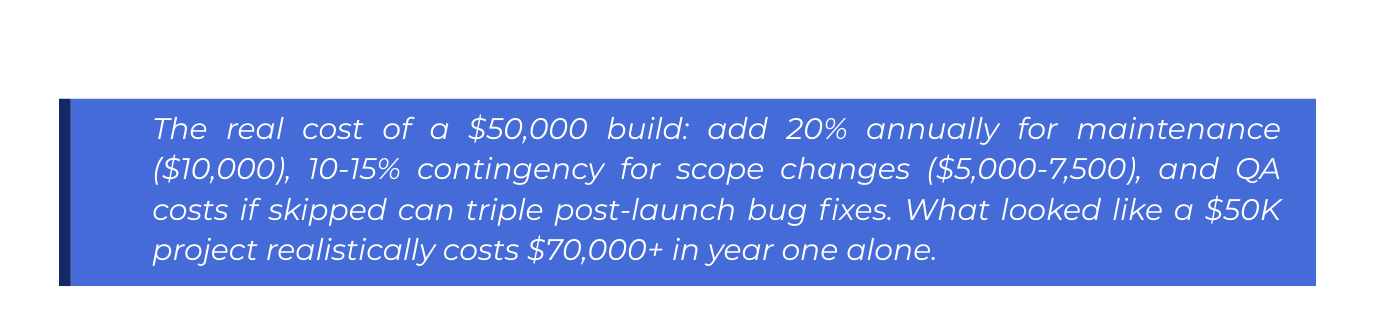
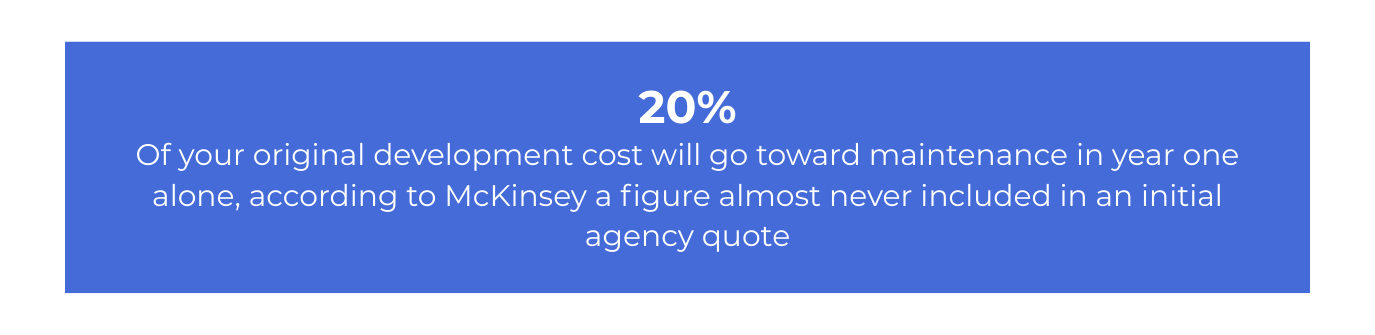
McKinsey puts this at 20 percent of the original development cost per year. On a $60,000 build, that is $12,000 a year minimum before you have added a single feature.
- Scope creep from unclear briefs:
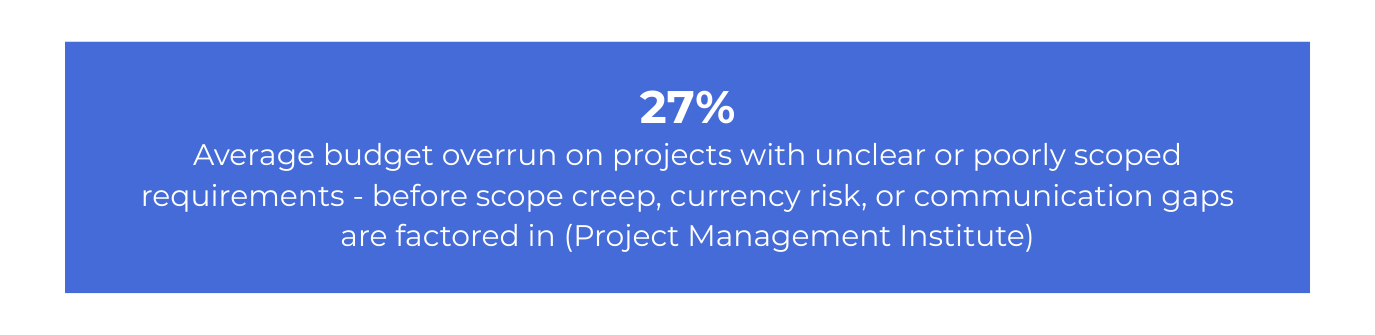
Projects with poorly defined requirements overspend by an average of 27 percent, according to the Project Management Institute. In a cross-timezone engagement, one misunderstood requirement costs more because feedback loops are slower.
- Technical debt:
McKinsey estimates that shortcuts taken during development add 20 to 40 percent to future maintenance costs. The cheap build that cuts corners now is the expensive rebuild six months from now.
- QA you skipped to save money:
Neglecting proper QA can increase post-release bug fix costs by up to 500 percent, according to research by Capers Jones. MVPs with proper testing have a 60 percent higher user retention rate. This is the line item founders cut most often and regret most reliably.
- Third-party integrations:
Each payment gateway, analytics tool, or external API adds both development time and ongoing monthly subscription cost. These are almost never in the initial quote.
The Real Developer Rates, by Country and Level
Africa is not one market. Developer rates vary dramatically by country and seniority. Here are the honest 2025 numbers, based on current salary data and agency benchmarks across the four key markets.
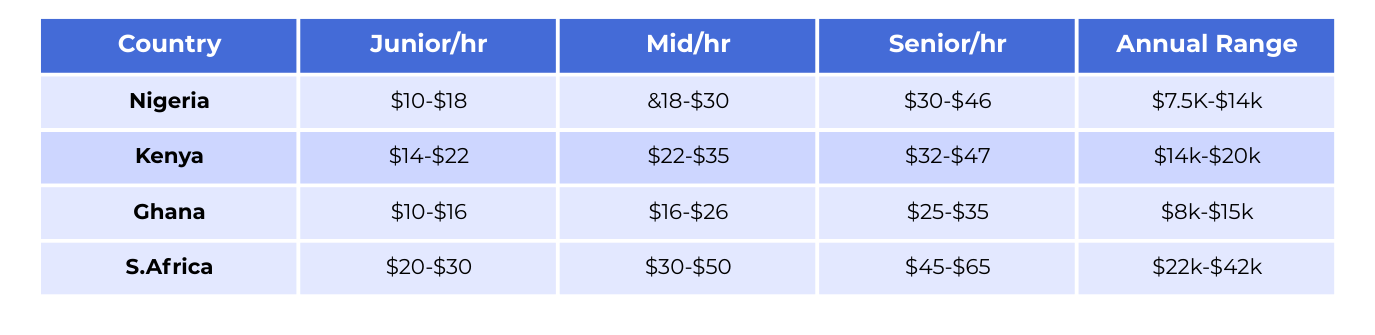
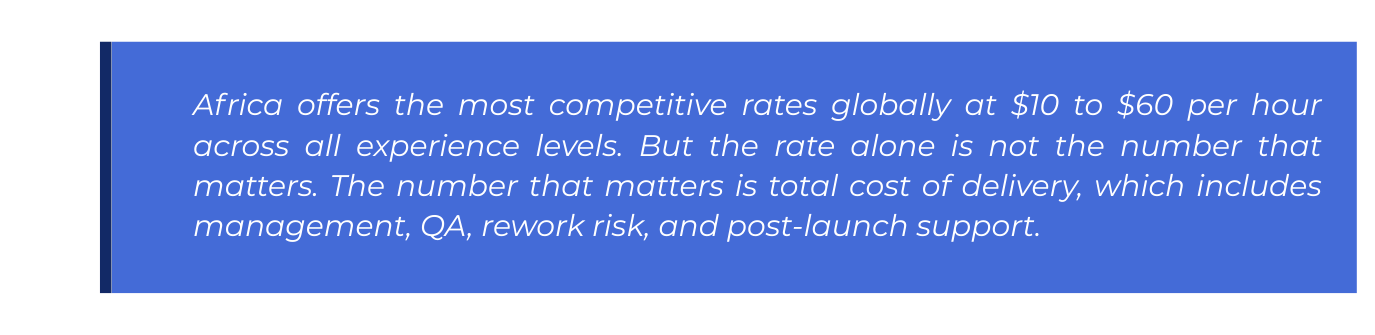
Important context: these are the underlying salary-equivalent rates. When you engage an agency, you are paying for the blended team cost plus project management, QA overhead, account management, and infrastructure. A fully managed agency engagement in Nigeria typically runs $25–$55/hour blended. In South Africa, expect $45–$75/hour blended. The rate you see on a proposal is not the developer's take-home rate. Factor the full cost of the managed engagement, not just the headline number.
For context, here is how African rates compare globally in 2026:
- North America: $80 to $200/hour
- Western Europe: $50 to $100/hour
- Eastern Europe: $35 to $70/hour
- Latin America: $30 to $60/hour
- Africa: $20 to $65/hour (range reflects country and seniority)
- Asia: $15 to $45/hour
The Three Budget Tiers: What You Actually Get at Each Level
Rather than giving you one range, here is a framework built specifically for African development costs. Three realistic tiers, based on what startups actually spend, not what they initially quote.
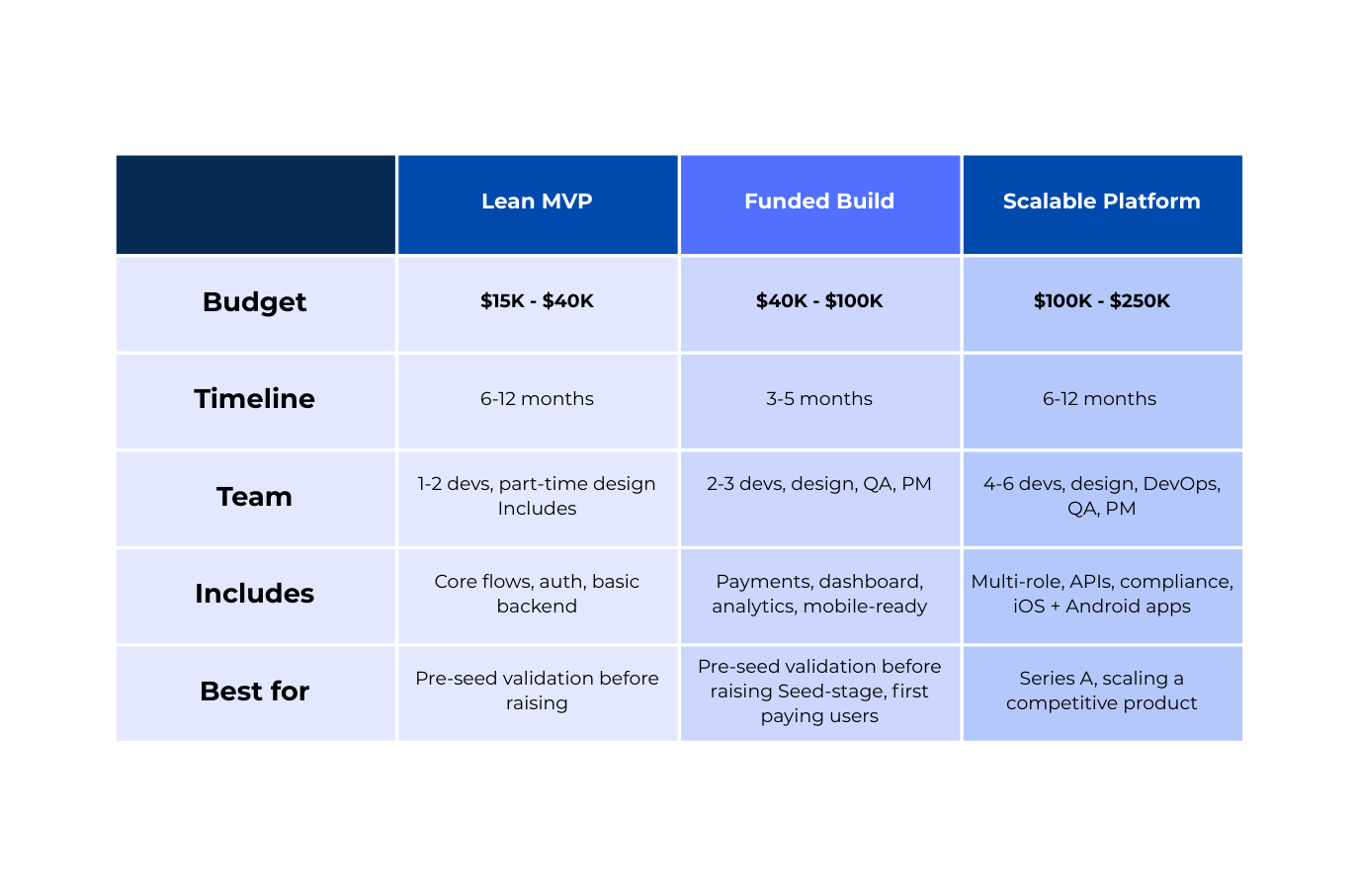
Tier 1: The Lean MVP ($15,000 to $40,000)
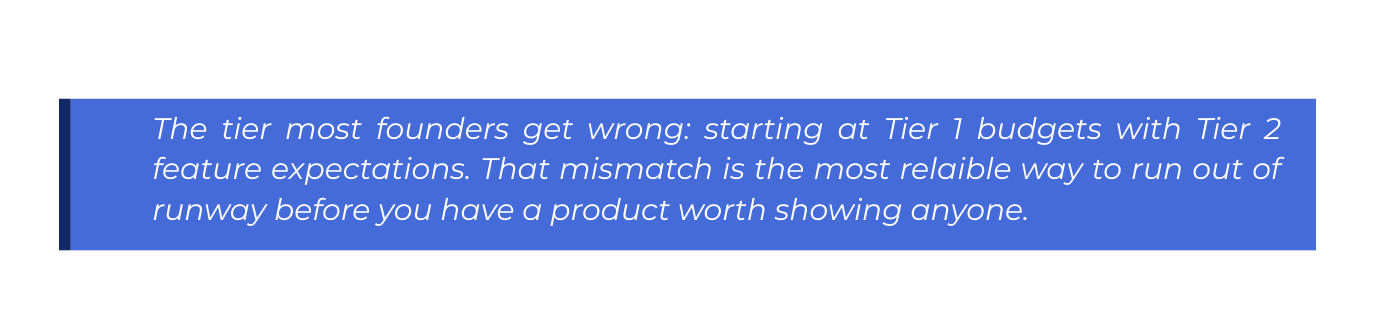
This is a real product built to answer one question: does anyone want this? You get core user flows, basic auth, and a working backend. Nothing more. Airbnb's first version let you book a room and confirm it. That was it. At this tier, fintech compliance, real-time features, and admin dashboards are Tier 2 conversations.
Where the budget goes: roughly 40 percent development, 20 percent design, 15 percent QA, 15 percent project management, 10 percent infrastructure and tooling.
Best for: pre-seed founders with $50,000 to $100,000 total runway who need to validate before raising.
Tier 2: The Funded Startup Build ($40,000 to $100,000)
This is a product ready for early paying users. Full auth and user management, payment integration, analytics, admin dashboard, and mobile-ready or basic mobile app. Most successful MVPs in 2025 are built by small, specialized teams of 3 to 5 people including a project manager, 1 to 2 developers, a designer, and a QA specialist. This is that team.
Best for: seed-funded startups building toward their first cohort of paying users.
Tier 3: The Scalable Platform Build ($100,000 to $250,000)
A product built to grow. Multi-role, integrations-heavy, and compliance-aware. Full iOS and Android apps, scalable cloud architecture, role-based access, reporting layers, and regulatory readiness if needed. A build that would cost $150,000 in the US can typically be delivered for $60,000 to $80,000 with an African team at the same quality level.
Best for: Series A or well-funded pre-Series A companies building a competitive, defensible product.
What Type of Product Are You Building? (Costs Vary More Than You Think)
Product type changes your cost profile significantly, even within the same budget tier. Here is what the numbers look like by product category at African development rates.
- Simple web app or internal tool:
$10,000 to $30,000. Basic CRUD, user auth, no complex integrations. The shortest timeline and smallest team of any product type.
- SaaS platform:
$40,000 to $120,000. Multi-tenancy, subscription billing, admin dashboard, onboarding flows. Backend-heavy and architecturally complex. Nigeria and Kenya both have strong depth here.
- Fintech or payment product:
$60,000 to $180,000 and above. Regulatory compliance, KYC flows, payment gateway integrations, and security standards all drive cost up. This is where Kenyan and Nigerian developers earn their specialisation premium. It is also where the cost of getting it wrong is highest.
- Mobile app (iOS and Android):
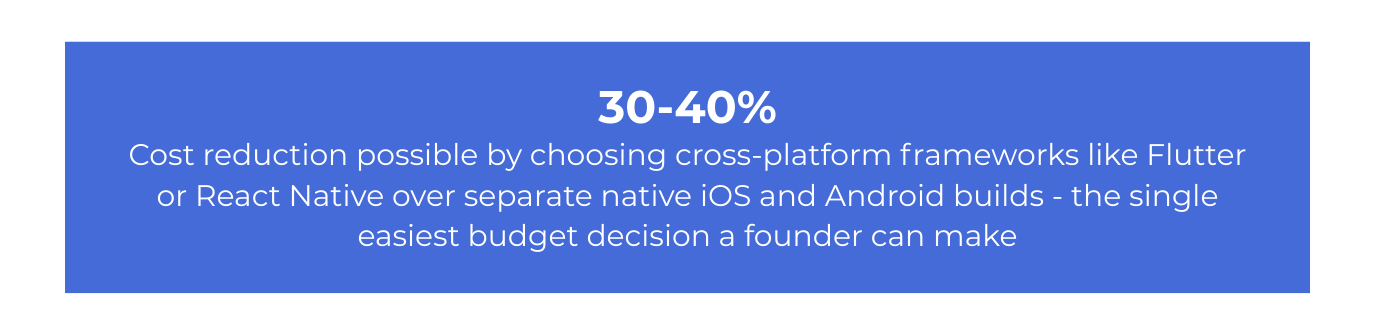
Add 30 to 40 percent to any web-only estimate. Cross-platform frameworks like Flutter or React Native can reduce this by 30 to 40 percent versus building native apps separately. For an MVP-stage product, there is almost never a user experience argument that justifies the native premium.
- Marketplace or two-sided platform:
$70,000 to $200,000 and above. Two user types, matching logic, payment escrow, trust and review systems. Complexity compounds fast.
The Hidden Costs That Blow Startup Budgets
This is the section nobody puts in their quote. These costs are real, documented, and almost universally underestimated by first-time founders building with African teams.
1. Post-launch maintenance
20 percent of original development cost per year, according to McKinsey. This is not optional. Every live product needs bug fixes, security patches, OS compatibility updates, and performance work. Budget for it from day one or find yourself without runway to fund it six months after launch.
2. Scope creep from a vague brief
The average project with unclear specifications overspends by 27 percent. The antidote is a paid discovery sprint before the build begins. A 2 to 3 week scoping engagement that costs $3,000 to $8,000 produces a requirements document that prevents $15,000 to $25,000 worth of rework. The most expensive thing you can do is skip discovery to save money.
3. Technical debt from a cheap build
Shortcuts taken to meet a deadline or hit a lower quote create code that is progressively more expensive to maintain. McKinsey estimates refactoring and fixing technical shortcuts adds 20 to 40 percent to future project costs. One startup documented in industry research spent $400,000 building an MVP and then $900,000 on a partial rewrite by year three because fundamental architecture decisions were wrong from the start.
4. Currency volatility for Nigeria-based teams
The Naira lost over 40 percent of its value in 2023 and 2024. When a developer's USD rate stays flat but their local purchasing power collapses, they look for something better. Retention risk mid-project is real. On engagements longer than 12 months with Nigerian teams, build cost-of-living adjustment clauses in or expect renegotiation pressure.
5. Communication gap rework
One sprint of rework on a 4-person African team costs $4,000 to $8,000 at blended agency rates. This happens when product requirements are vague and the founder is not available for timely feedback. It is not a talent problem. It is a process problem. Weekly check-ins, clear documentation, and defined acceptance criteria prevent it.
6. Compliance you retrofitted instead of building in
If you are building in fintech, health tech, or any regulated space and you do not design for compliance from day one, you will pay for it later. Annual post-launch support for B2B applications typically absorbs $20,000 to $50,000 per year. Retrofitting compliance into an existing codebase is always more expensive than building it in from the start.
How to Make Your Budget Go Further Without Cutting the Wrong Things
These are the decisions that separate founders who get a real product from those who get a half-finished one.
- Start with a discovery sprint, not a full build quote.
A 4-week paid sprint ($3,000 to $8,000) that produces a detailed requirements document makes every cost estimate that follows more accurate. Skip it and you are building on guesswork.
- Use cross-platform frameworks.
React Native and Flutter reduce mobile development costs by 30 to 40 percent versus separate native builds. There is almost no MVP-stage argument for native apps.
- Use design systems and UI kits.
Building a custom design from scratch at MVP stage adds cost and time. Material UI, Tailwind UI, and similar systems reduce design hours by 30 to 50 percent without meaningfully affecting user experience.
- Cut features, not QA.
A smaller, well-tested product is always worth more than a larger, broken one. QA is consistently the most underfunded line item in startup builds and one of the most consequential to cut.
- Budget 10 percent of your build cost for post-launch maintenance from day one.
Not as a contingency. As a line item. Whatever your build costs, reserve 10 to 15 percent for the first six months of post-launch support.
- Use milestone-based payment schedules.
Not time-based billing. Deliverable-tied milestones protect you and create aligned incentives. If a scope milestone slips, payment structure creates natural accountability.
The Number Founders Actually Get Wrong
It is not the hourly rate. The rate is usually close enough. The number founders get wrong is the total cost of building and maintaining a product over 12 months after launch, not just the cost of the initial build.
Africa's developer market gives you a genuine cost advantage over almost every other outsourcing destination. The question is whether you use that advantage to build something real and sustainable, or to build something that looks cheap in the proposal and expensive in hindsight.
The startups that win are not always the ones that spent the least. They are the ones that scoped clearly, budgeted honestly, and built with the right team for the right product type at the right tier.
That is the number that matters. Everything else is a headline.