
QA Strategy for Startups Outsourcing Product Development
Software Engineering
Let me tell you about a failure pattern I have seen more times than I can count.
A founder hires an offshore development team. The team is good. They ship fast. The product looks great in demos. Then the startup does its first real launch, a few hundred users flood in, and three critical bugs appear within 48 hours. Users tweet about it. The founder goes from excited to panicked in a single afternoon. The offshore team gets blamed. Retrospectives are had. Everyone is confused about what went wrong.
Here is what actually went wrong: there was no QA strategy. Not a bad one. None at all.
The assumption was that the developers would test their own work, the product manager would click around before each release, and real bugs would be caught before they caused damage. That assumption is wrong every single time.
This is not a post about why QA matters. You already know quality matters. This is about how to build a QA strategy that actually functions when your development team is distributed, offshore, or fully outsourced which is increasingly the situation for startups moving fast with lean budgets.
The Problem Nobody Warns You About
When you outsource product development, you solve one problem (hiring and team-building speed) and accidentally create another (accountability for quality). In a co-located team, quality issues surface fast. Someone walks over to a developer's desk, sees a broken UI, and flags it immediately. In an outsourced setup, those same issues can travel all the way to production without anyone catching them, because there is no shared physical environment, and the handoff rituals are weak.
Communication barriers are the most common cause of failure in outsourced QA. Vague requirements force teams to make assumptions that differ from expectations. Visual communication through screenshots and screen recordings is consistently more effective than text specifications alone — yet most outsourced setups default to text-heavy Jira tickets and hope for the best.
The root issue is not that offshore developers are less careful. It is that outsourced product development creates structural gaps where quality falls through. Nobody explicitly owns the quality layer. The developer thinks the client will test it. The client thinks the developer will test it. And nobody tests it.
A proper QA strategy for outsourced teams closes those gaps deliberately.
Why the Stakes Are Higher Than You Think
There is a well-documented principle in software engineering called the 1-10-100 rule. The rule states that a bug costs $1 to fix in design, $10 in development, and $100 in production.
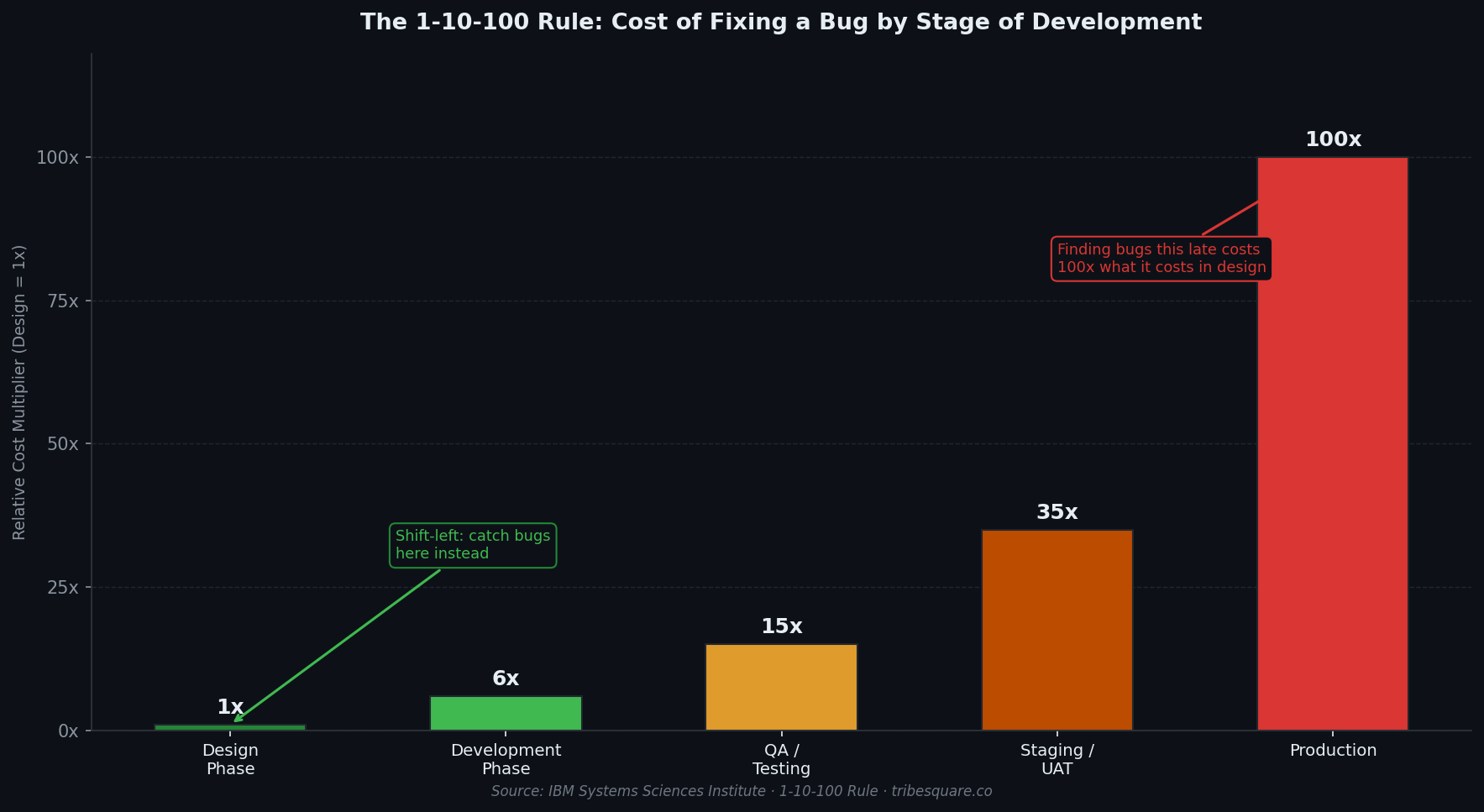
Research from the IBM System Sciences Institute confirms that defects found during the testing phase can be 15 times more costly than those caught during design, and twice as costly as those found during implementation. And when a bug escapes into production, the cost is not just the developer hours. It is customer support tickets, user churn, emergency sprints, reputation damage, and the kind of investor conversation you do not want to be having.
For a startup, those multipliers are material. According to TechCost Analysis 2025, addressing bugs at the final release stage can increase project costs by as much as 50%. On a 12-month runway, that is a number that changes outcomes.
The good news is that having any structured QA strategy, even a lightweight one, dramatically changes the equation. The question is how to build that structure when your engineering team is outsourced and distributed.
Understanding What You Actually Need at Each Stage
The biggest mistake startups make with QA is treating it as binary: either you have a full QA department or you have nothing. The right QA setup changes significantly depending on where you are in your growth cycle.
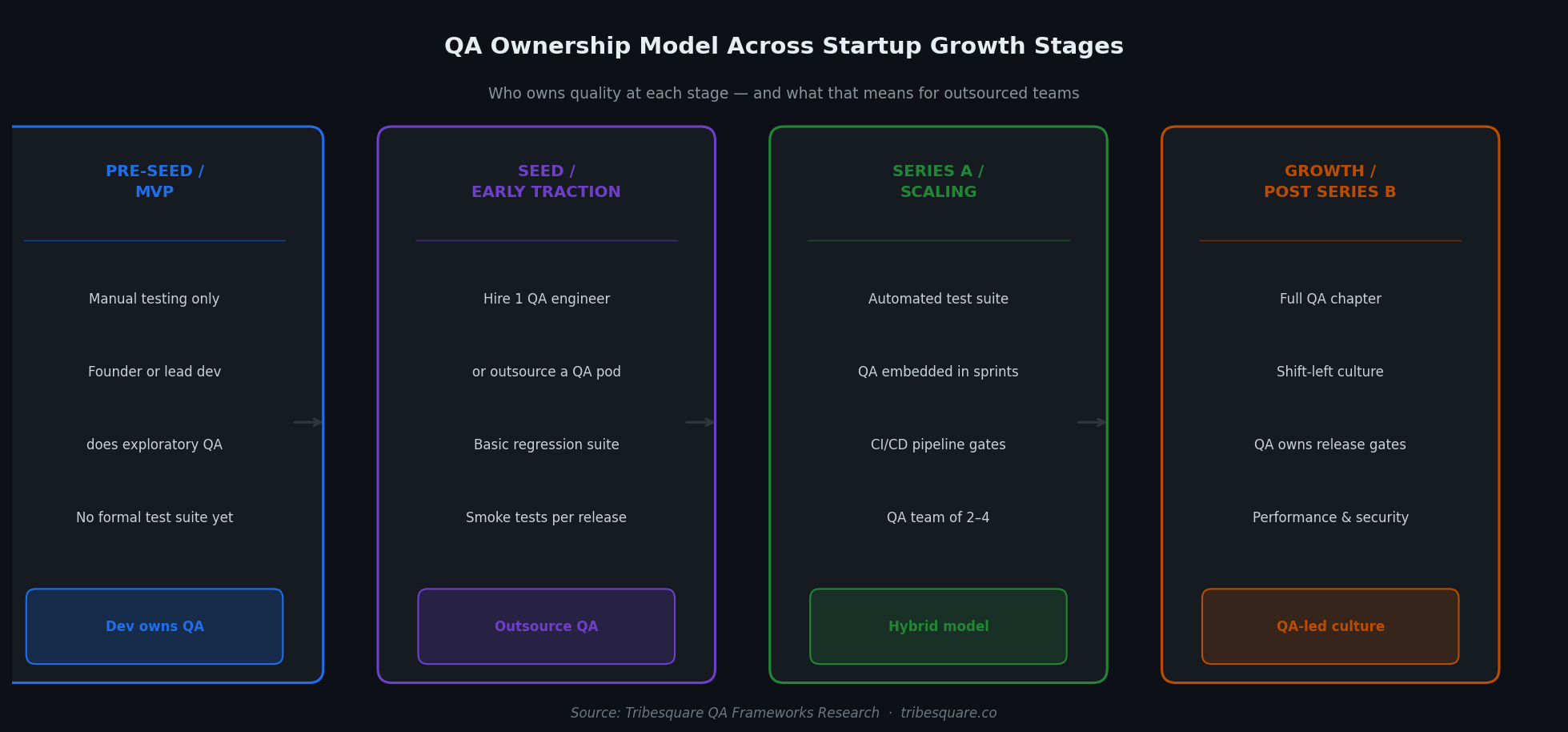
Here is how this plays out in practice.
Pre-seed and MVP stage. You have a small outsourced team building your first version. You do not need a dedicated QA engineer yet. What you need is structured exploratory testing by the product lead, a basic checklist of critical paths that must work before any release, and developers who write unit tests as a non-negotiable part of their definition of done. If the outsourced team you are working with does not write unit tests, that is a red flag to address before the first line of feature code is written.
Seed stage and early traction. You now have users. Users find bugs your team did not. This is the stage where you either hire one QA engineer or outsource a dedicated QA pod to your existing development partner. The objective here is a regression test suite, smoke tests that run before each deployment, and a bug triage process that your offshore team can execute autonomously. The QA function starts to separate from development. You want someone whose entire job is to break the product before users do.
Series A and scaling. Automated testing is now a business requirement, not a nice-to-have. Your CI/CD pipeline should have quality gates. No PR merges without passing tests. No deployment without a green build. Teams need concrete targets here: reduce post-release defects by 50%, achieve an 80% early detection rate, or cut mean time to detect from 5 days to 5 hours. This does not happen automatically with an outsourced team — it requires explicit contract terms, shared tooling, and a dedicated QA layer.
Growth stage and beyond. QA is now a culture, not just a function. QA engineers participate in sprint planning, backlog refinement, and architecture reviews. They are upstream collaborators, not downstream filters.
The Shift-Left Principle Is Twice as Important for Outsourced Teams
Shift-left testing means moving quality checks earlier in the development cycle, away from the end of a sprint and toward the beginning. For in-house teams, shift-left is good practice. For outsourced teams, it is genuinely critical.
Here is why. When your developers are in a different timezone and a different organization, the cost of a feedback loop is high. If a QA engineer catches a bug at the end of a two-week sprint, the developer who wrote that code has already mentally moved on to the next task. Context-switching them back to a two-week-old decision is expensive in time, morale, and money. Catching that same issue on day two of the sprint, before the code is even fully written, is almost free.
In Agile environments, shift-left testing combines testing activities from the start of the software development lifecycle rather than waiting until the end. Testers participate in requirement gathering and project planning. They assist in defining testable user stories and measuring acceptance criteria to catch logic mistakes before coding begins.
The practical implementation for outsourced teams looks like this. QA engineers review user stories before development starts, flagging ambiguous acceptance criteria that will cause rework later. Developers are required to write unit tests alongside feature code, not after. Integration tests run on every pull request, blocking merges that break existing behavior. The QA engineer participates in the sprint kickoff, even asynchronously, to understand what is being built and flag potential test complexity early.
In mature outsourced setups, testers act as quality consultants who guide developers on drafting better tests and help design the entire automation strategy. Quality becomes a collective team goal rather than the duty of a separate department.
Getting an outsourced team to this level requires deliberate contract design, not just tooling. Your statement of work needs to explicitly define QA deliverables: test plans per feature, coverage thresholds, defect leakage rates from staging to production, and regression test suite maintenance.
The Five Components of a Real QA Strategy
A QA strategy for outsourced product development has five layers. Most startups are missing three of them.
Test planning and ownership documentation. Before your offshore team writes a single line of code for a feature, there should be a test plan. This does not need to be a 20-page document. It can be a section of the user story card that defines what the happy path looks like, what the failure modes are, who is responsible for testing, and what the acceptance criteria are. The discipline of writing this down forces clarity that prevents 80% of the bugs that eventually become production incidents.
A regression suite that the team actually maintains. Regression bugs — where a new code change breaks existing functionality — are the most common and most damaging class of bugs in fast-moving startups. A robust regression testing strategy is the most effective safety net to prevent this. Your offshore team needs to maintain this suite as a living artifact. Any feature they build should add to it. Any bug they fix should have a test written to prevent recurrence.
CI/CD quality gates. Every professional outsourced engineering engagement in 2025 should have automated tests running in a CI/CD pipeline. If your current offshore team does not have this configured, stop treating it as optional and start treating it as a sprint-zero deliverable. Quality gates mean that code that breaks tests cannot merge to the main branch. This removes the possibility of quality degrading silently over time.
Exploratory testing cadence. Automated tests only catch what you thought to test for. Exploratory testing, where a QA engineer interacts with the product in unscripted ways, catches the things that fall between the tests. For outsourced teams, this works best as a structured weekly or bi-weekly session with clear notes fed back to the product and development team. Visual communication through screenshots and screen recordings is more effective than written summaries of what was found.
Defect triage and SLA definitions. Not all bugs are equal, but your outsourced team needs to know how you rank them. A critical bug that blocks a core user flow should have a 24-hour resolution SLA. A cosmetic issue can wait for the next sprint. Define these categories in your contract and revisit them in sprint reviews. Defining expectations upfront reduces misunderstanding and strengthens accountability, which includes KPIs for regression coverage, defect leakage, and release readiness.
The QA Tool Stack That Actually Works for Outsourced Teams
Good tools do not replace a good strategy, but they operationalize it. Here is what a startup-appropriate QA tool stack looks like when the development team is outsourced.
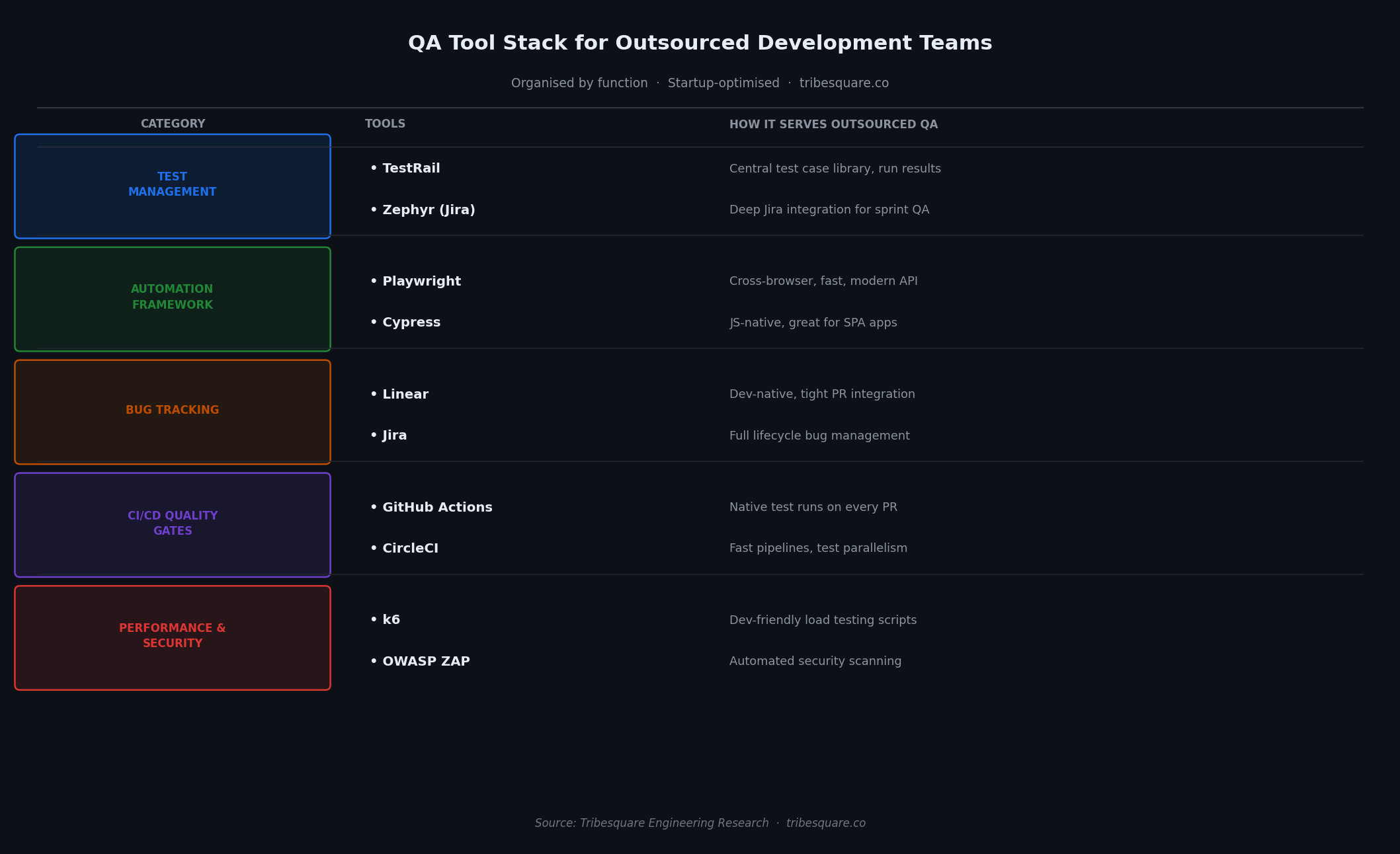
For test management, Qase.io has become the preferred tool for startups because it is modern, fast to set up, and avoids the bureaucratic overhead of tools designed for enterprise QA departments. For teams already in the Atlassian ecosystem, Zephyr Scale inside Jira keeps everything in one place. TestRail is the enterprise-grade option for teams managing larger test libraries across multiple products.
For test automation, Playwright has largely won the modern web automation debate. It handles cross-browser testing natively, has excellent TypeScript support, and its trace viewer makes debugging failed tests in distributed teams significantly easier. Cypress remains strong for JavaScript-heavy single-page applications. For mobile, Appium is the standard.
For CI/CD quality gates, GitHub Actions is the default for teams on GitHub, integrating cleanly with Playwright, Cypress, and most test frameworks. Allure Report generates test execution dashboards that are readable by non-engineers, which matters when you are reviewing quality metrics in sprint retrospectives with an outsourced team that may not share your product context.
For bug tracking, your existing project management tool should handle this. Linear is the preferred option for engineering-led teams as covered in our guide to managing African offshore development teams. For teams on Jira, the native bug workflow works fine when configured with proper priority tiers.
For performance testing, k6 has changed the game for startups. It uses JavaScript, which your developers already know, and lets you write load tests that live in the same repository as your application code. Performance testing is not an enterprise-only concern. Any startup with more than a few hundred concurrent users needs to understand how their product behaves under load before a launch event, a press mention, or a viral moment turns into a downtime incident.
For security, Snyk for dependency vulnerability scanning and OWASP ZAP for automated security testing of your API layer. Security and compliance risks in outsourced QA: including lack of transparency, reduced control over test quality, communication breakdowns, and non-compliance are mitigated by choosing partners with clear SLAs, real-time dashboards, and strong data governance from the start.
The Contract Design Problem Nobody Talks About
Here is the thing that separates QA strategies that work from QA strategies that look good in a slide deck: contract design.
Most startup founders negotiate outsourcing contracts around feature delivery. Pages of user stories, acceptance criteria for each feature, milestone payments tied to shipping. QA is treated as an implicit expectation baked into "good development practice."
That implicit expectation will fail you.
Your contract or statement of work with an outsourced development team needs explicit QA deliverables. Specifically: a test coverage requirement, usually stated as a percentage of critical paths covered by automated tests; a defect density benchmark, meaning a maximum acceptable number of bugs found in QA per sprint; a defect leakage rate, meaning the percentage of bugs that should not escape from staging to production; a test plan requirement for every new feature; and an obligation to maintain the regression suite so it does not decay as the codebase grows.
Without these in the contract, your offshore team has no structural incentive to invest in quality. They are incentivized to ship features. That is what they were hired to do, and it is what they will optimize for unless you build quality checkpoints into the commercial relationship itself.
Overpromising vendors are real. Watch for outcome-based contracts with clear SLA definitions, not fuzzy guarantees about "high quality standards."
The Release Readiness Checklist: The Small Ritual That Changes Everything
There is one practice that consistently separates well-run outsourced QA from broken outsourced QA, and it is embarrassingly simple: the release readiness checklist.
Before any deployment to staging or production, the offshore team runs through a defined checklist. It includes: all automated tests passing, regression suite green, critical user flows manually verified, no open P1 or P2 bugs, performance benchmarks within acceptable range, security scan clean.
This is not bureaucracy. It is a forcing function that requires someone to explicitly confirm quality before code moves forward. It replaces the silent assumption of "it's probably fine" with an affirmative sign-off.
The checklist lives in your project management tool. It is attached to every release ticket. It takes 15 minutes to complete. And it consistently catches two to three issues per release that would otherwise have become production incidents.
When you are working with an outsourced team, this checklist is also how you build a shared quality culture across organizational boundaries. Over time, the team internalizes the checklist as their own standard, not an external requirement imposed by the client. That shift from compliance to ownership is when your QA strategy matures from a process into a culture.
Common Failure Modes (and How to Avoid Each One)
"We'll test it after launch." This is the most common and most expensive failure mode. The outsourced team ships an MVP. The founder demos it to investors, runs a limited beta, declares it good enough. Six weeks later, at scale, everything breaks. The fix costs three sprints. The lesson: even an MVP needs a minimum viable test suite. Five to ten critical path tests, automated, running on every deploy. Non-negotiable.
"Developers test their own code." Developers are the worst people to test their own code. Not because they are careless, but because they test what they built, not what was needed. They know the happy path and naturally navigate toward it. A separate QA eye, even a part-time outsourced one, catches edge cases, error states, and real-user behavior that developers never think to test.
"Our offshore team handles QA internally." This is the delegation trap. You assume the offshore development company has its own QA process. They might. But their QA process is designed to satisfy their definition of done, which may not match yours. Without explicit quality standards in your contract and shared tooling that gives you visibility, you are flying blind.
"We have 100% test coverage." Test coverage is a dangerous metric. A test suite with 100% code coverage can still miss critical user journeys if the tests are poorly written. Coverage tells you what was executed, not what was verified. Focus instead on defect leakage rate (how many bugs reach production that should have been caught in QA), mean time to detect (how quickly does your test suite catch a regression), and mean time to resolve (how fast does the team fix confirmed bugs).
Where We Fits Into This Picture
The hardest part of building a QA strategy for an outsourced team is finding a partner who takes quality seriously at the structural level, not just as a checkbox in a sales pitch.
Most outsourcing arrangements put quality in the background. The pitch is about speed, cost, and developer headcount. QA is mentioned in passing, treated as something developers handle as part of their workflow.
Tribesquare is built differently. As a company that provides fully-managed engineering teams to growing businesses in Africa and across the world, Tribesquare's approach to team assembly goes beyond technical vetting. Engineers placed on your team are evaluated on their ability to write testable code, maintain regression suites, and work within CI/CD quality frameworks. The vetting goes beyond resumes to test technical skills, soft skills, and the kind of engineering discipline that makes quality sustainable at pace.
When you engage Tribesquare for a managed team or full product build, you are not getting a group of developers who disappear when the sprint is done. You are getting a team that participates in your release rituals, adapts to your quality standards, and treats your product's stability as a shared responsibility.
For founders who want to outsource product development without handing over control of quality, that distinction matters enormously. The conversation starts at tribesquare.co.
A Minimum Viable QA Strategy
For a seed-stage startup with an outsourced development team, here is the floor below which you should not operate.
Define your critical paths. What are the five to ten user flows that, if broken, would constitute a serious incident? Write them down. These become your smoke test suite.
Require unit tests as part of the definition of done. Every feature ticket should have a "unit tests written" checkbox. If the sprint review does not include a demonstration of passing tests for the new feature, the feature is not done.
Set up a CI/CD pipeline that runs tests on every pull request. GitHub Actions with a Playwright or Cypress suite is the minimal configuration. Two to three hours of setup once prevents hundreds of hours of regression debugging across a year.
Run a regression pass before every staging deployment. This can be manual at early stage. Someone, ideally not the developer who wrote the code, runs through the critical paths defined above and confirms nothing is broken.
Track defect leakage. Count how many bugs reach production that should have been caught in QA. Start with the number you have today. Set a target to reduce it by 50% in 90 days. Review it in every sprint retrospective.
Five practices. All implementable within two sprints of your outsourced team's time. All measurably improving your product stability and your team's confidence in shipping.
Quality is not a feature you build after product-market fit. It is the foundation that makes product-market fit possible.
Tribesquare helps global companies build faster and smarter by connecting them with Africa's finest engineers. From individual developer placement to fully managed product teams, the vetting, compliance, and quality standards are built in from day one. Start the conversation at tribesquare.co.