Nigerian Software Developers: What Global Companies Need to Know Before Hiring in 2026
Hiring African Developers
Something changed in how global CTOs talk about engineering talent in the last two years. Nigeria went from being a footnote in outsourcing conversations to being a first question. The GitHub CEO calling top Nigerian talent world-class helped. Paystack's acquisition by Stripe for $200 million helped more. Flutterwave hitting a $3 billion valuation and processing payments for Uber, Netflix, and Microsoft settled the argument for a lot of people.
But there is a difference between knowing that Nigeria has serious engineering talent and knowing enough to actually hire from it well. Most of the content written about Nigerian developers is either cheer-leading that omits the real constraints, or outdated guides that quote stale salary figures and miss the depth of the current ecosystem.
This article is the buyer's guide that does not exist anywhere else. It covers what the talent pool actually looks like by seniority level, which stacks run deep and which run thin, what you should expect to pay and how to pay it, what the infrastructure caveats actually mean for a remote team, and how to vet engineers so you get the real thing rather than the inflated title that has become a known problem in the market.
The Numbers First: Why Nigeria Is a Different Conversation Now
Start with the data that most outsourcing articles ignore. GitHub's 2024 Octoverse report recorded over 1.1 million developers building on GitHub in Nigeria, a 28% year-on-year increase. Nigeria rose from rank 20 globally in Q1 2020 to rank 11 in Q4 2024. That is not incremental growth. That is a structural shift in the size and activity of the developer population.
Nigeria reached approximately 1.4 million developers, representing 31% year-over-year growth, making it the largest developer community in Africa. CoinLaw South Africa followed at 800,000 (26% increase) and Kenya at 500,000 (36% increase) in late 2025.
What is driving this? Three things working simultaneously. Local fintech companies have created a training ground without parallel elsewhere on the continent. Building payment infrastructure for a market as complex and constrained as Nigeria's teaches engineers things that a decade of enterprise CRUD applications does not. Flutterwave, Paystack, Moniepoint, Kuda, OPay, and dozens of second-tier fintechs have produced a cohort of engineers who have solved genuinely hard problems under real conditions.
Second, government and private training programmes have scaled. Microsoft trained 4 million Nigerians in digital and AI skills by December 2024 and certified 70,000 of them. The federal 3MTT programme has a target of 3 million technical talents. Data Science Nigeria runs AI bootcamps. Decagon, Andela, and AltSchool Africa are producing graduates with practical skills and international client exposure.
Third, remote work normalised dollar-denominated compensation. The combination of naira devaluation and global demand for remote developers has created a generation of Nigerian engineers who benchmark against international rates, work in async-first environments, and have direct experience shipping products for US and European clients.
What You Should Actually Expect to Pay
Salary data for Nigerian developers is genuinely confusing to read from outside the country because three separate markets exist simultaneously and most published figures blend them into a single useless average.
The first market is local employment in Nigerian naira. The second is remote work for international companies, paid in USD. The third is through platforms like Andela or Toptal, where the platform takes a margin and presents a blended rate. If you are hiring directly, the only number that matters is the second one.
Salary research across multiple sources puts the USD-equivalent compensation for Nigerian software engineers working for international companies in the following ranges for 2025. These are the numbers that reflect what you should budget, not the naira-denominated local market figures that circulate in most salary guides:
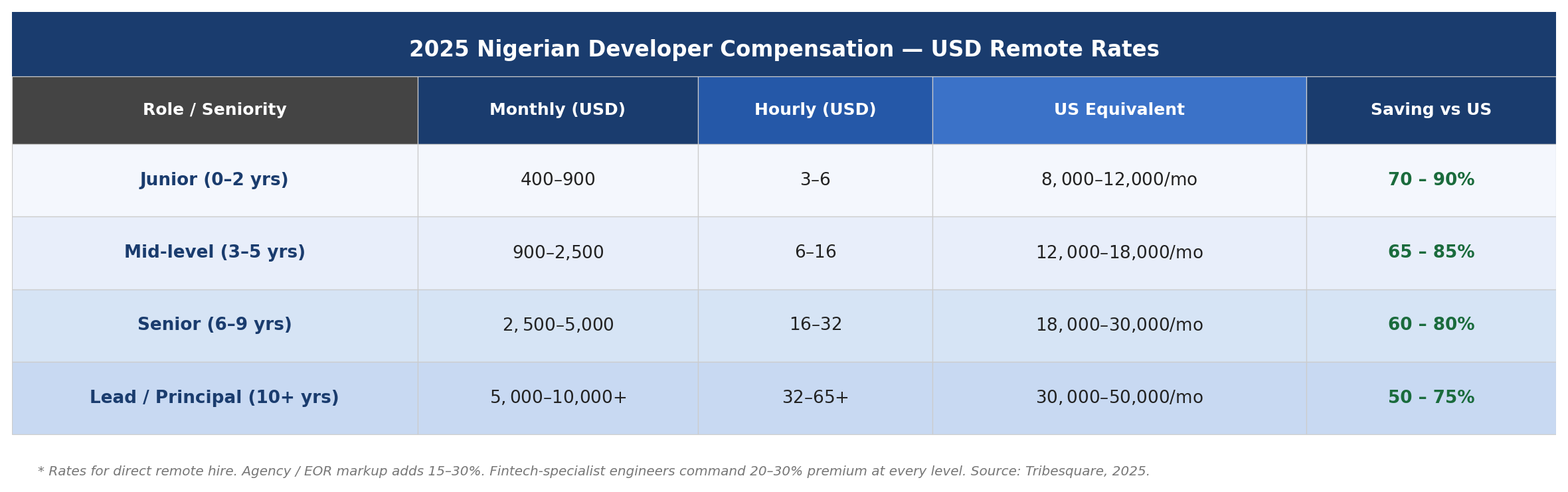
A few things to read carefully in that table. The savings against US rates are real and significant. They are not the only reason to hire from Nigeria. The engineers at the top of the Nigerian market are priced at their level because they are genuinely good, not because they are cheap. If you approach this market purely as a cost arbitrage play you will screen out the engineers you actually want.
The market has also developed a specific problem: title inflation. Three to four-year engineers are routinely being hired locally as seniors. If you are hiring based on a job title rather than a structured technical assessment, you will consistently get developers who are one level below what the title implies. This is not unique to Nigeria but it is more pronounced here than in more mature hiring markets. The fix is straightforward: assess for the level you need, not the label the engineer carries.
Which Stacks Run Deep and Which Run Thin
The question that most hiring guides skip is the one that actually determines whether a hire will work: does Nigeria have depth in your specific technical domain? The answer varies significantly by stack and it is worth knowing before you start
The fintech advantage deserves its own paragraph
Nigeria's fintech ecosystem is not just large, it is operationally sophisticated in ways that matter for product engineering. Paystack processes over $250 million in monthly transaction volume and handled three billion API requests in Q4 2024 alone. Moniepoint processes over 800 million transactions monthly and is profitable. Flutterwave has processed more than $34 billion across 890 million transactions operating in 34 African countries.
The engineers who built and scaled those systems are in the Lagos talent pool. If your product involves payment processing, wallet logic, KYC flows, fraud detection, financial API design, or anything adjacent to how money moves at scale, you will find engineers in Nigeria who have solved that problem for a market more constrained and more demanding than most Western payment systems require.
The blockchain signal is also real. According to Hashed Emergent's 2024 report, Nigeria accounts for 3% of global blockchain developers and contributed 4% of the newest entrants to the global blockchain talent pool. For a Solidity or Rust (Solana) hire, Nigeria is a genuine top-tier option.
How to Vet Nigerian Engineers: What Works and What Does Not
The vetting standards that work well in more mature hiring markets are not sufficient here. The market has specific characteristics that require specific countermeasures.
What does not work
- CV screening on titles alone. As noted above, title inflation is a known market characteristic. A senior title in the local market often maps to mid-level by international standards. Screen for output and depth, not designation.
- Portfolio without verification. GitHub profiles can be impressive without reflecting the depth of contribution. Ask specifically what the engineer built, what decisions they made, what broke, and how they fixed it. The answers to those questions reveal actual seniority.
- One-stage technical interviews. A single coding test will not distinguish a strong mid-level engineer from a weak senior. Use a structured interview that includes a systems design component. System design separates the levels more reliably than algorithm problems.
What does work
- A paid trial sprint. The most reliable signal of how an engineer will actually perform is a small, bounded paid project — a real task from your backlog, not a synthetic test. Two to three days of work on something real tells you more than a 90-minute interview.
- Async communication quality. Request a written technical walkthrough of something the engineer has built. The quality of written technical communication — the ability to structure a problem, explain a decision, and acknowledge a tradeoff — is a stronger predictor of remote work success than any algorithm problem.
- Reference check with the client, not the company. If the engineer has worked for an international client before, speak to the product manager or CTO on the client side. A five-minute call will tell you whether they delivered, communicated well, and handled ambiguity like a senior engineer should.
- Live debugging, not just coding. Give the engineer a broken codebase and watch how they approach it. Debugging reveals how someone actually thinks when things go wrong, which is when you most need an engineer to think clearly.
How to Pay Nigerian Developers: The Practical Reality
Payment infrastructure is the part of hiring Nigerian developers that surprises most international companies the most. Here is the honest picture.
PayPal has undergone a significant shift. For over a decade, Nigerian accounts were restricted to send-only, but in January 2026, PayPal launched a partnership with Paga, a leading Nigerian fintech enabling Nigerian users to receive international payments from over 200 countries and withdraw funds in Naira for the first time in nearly two decades. However, the rollout still has friction: in Nigeria, PayPal accounts are still limited to sending payments and making purchases by default, and receiving funds directly is not straightforward for all users.Treat it as an emerging option, not a solved one. Wise's position is similarly nuanced. Wise resumed naira payouts to Nigeria in 2024, aligned with CBN's updated remittance guidelines, but terminated direct dollar transfers in the process. The Wise debit card is not available to Nigerians, and you cannot receive USD directly into Nigeria through the platform making it only useful if your contractors' clients pay in GBP. Do not assume that the payment method you use for European or LATAM contractors will work here without verification.
What actually works
- Deel. The cleanest option for ongoing contractor or employment relationships. Deel handles the contract, compliance, and payment in one platform. Nigerian contractors on Deel can withdraw in USD or to local banks. This is the most friction-free option for a first international hire.
- Payoneer. Well-established, integrates with Upwork and Fiverr, supports withdrawal to Nigerian partner banks. Annual card fee applies. Not the cheapest option but reliable and familiar to most Nigerian freelancers.
- Grey / Geegpay. Nigerian fintech platforms that give developers virtual USD accounts for receiving direct payments from international clients. Both have competitive exchange rates and fast local withdrawal. Good option if you are paying direct rather than through a platform.
- SWIFT bank transfer to a Nigerian domiciliary account. Works, but adds 3 to 5 business days of settlement time and carries less favourable exchange rates than fintech alternatives. Best for larger monthly disbursements where the fee percentage is lower.
On employment classification
Most international companies hiring Nigerian developers do so on an independent contractor basis rather than as formal employees. This is practical and legally workable but carries the same misclassification risk that applies in any country. If the arrangement is full-time, long-term, and highly directed, an Employer of Record (EOR) structure through Deel, Remote, or a local Nigerian EOR provider is the cleaner setup. If you are running a project-based engagement with multiple engineers, a formal services contract with a Nigerian agency is the most legally straightforward structure.
The Honest Caveats: What to Plan Around
Every article about hiring in Nigeria eventually gets to power and internet reliability. Most of them treat it as either a non-issue or a dealbreaker. Neither is accurate. Here is the correct frame.
Power infrastructure
Nigeria's power grid is genuinely unreliable. Nigeria's available generation capacity in 2025 remained far below what its 242 million population requires, and most urban professionals rely on a combination of grid power, generators, and increasingly solar-plus-battery inverter systems to maintain consistent access. Senior engineers working for international companies in Lagos almost universally have backup power solutions. It is a baseline professional necessity in the Lagos market, not an exceptional circumstance. The practical effect on a remote engagement is: most senior engineers you hire will have reliable power. The risk is higher for junior engineers and for hires outside Lagos and Abuja.
What you should do: ask directly about their setup during the interview process. Any engineer who has worked for an international client before will have solved this. Any engineer who has not may need time to invest in a solution, and some companies front this cost as part of the onboarding.
Internet connectivity
Broadband penetration in Nigeria stood at 48% in mid-2025, short of the government's 70% target. 4G subscriptions reached 50.85% of active subscriptions by July 2025, and Lagos has strong mobile data infrastructure from MTN and Airtel. Fibre-to-the-home is expanding but remains primarily urban. In practice, senior engineers in Lagos are on reliable 4G or fibre connections. Video calls, async communication, and code collaboration work without the friction you might expect from reading the infrastructure statistics. Where you can encounter issues is in rural areas or during city-wide network events.
What you should do: standard remote onboarding practice applies. Set up asynchronous defaults so that a dropped connection on a call does not block the work. This is good practice for any distributed team regardless of geography.
Currency volatility and compensation planning
The naira's recent history is more dramatic than the original framing captured. Bloomberg ranked the naira the worst-performing currency in 2024, after it dropped roughly 70% in a single year, hitting record lows near ₦1,738 per dollar at the official market and ₦1,900 at the parallel market. Punch 2025 told a different story. Aggressive monetary tightening by the CBN — raising interest rates to 27.5%, one of the highest policy rates in the world — helped curb speculative attacks and attracted foreign portfolio investors. External reserves climbed to over $50 billion, the highest in 13 years. The result is that the naira has clawed back toward the ₦1,350–₦1,450 range in early 2026, entering what analysts describe as a phase of fragile stability. As of this writing, the official rate sits around ₦1,386–₦1,389 per dollar, with the parallel market trading at ₦1,400–₦1,410."Fragile" is the operative word — without substantial improvements in dollar supply through legitimate channels, continued depreciation pressure remains the base case for 2026. For a company paying in USD, this is not directly your problem but it is very much your engineers' problem if you are not. Any naira-denominated salary set 18 months ago has already lost significant real value, and your developers know it. Pay in USD. Index adjustments to the USD value, not the naira value. In a currency environment this volatile, that single decision does more for retention than any other compensation lever available to you.
How to Start: Three Practical Routes Into the Market
Route 1: Direct hiring through platforms
Post on LinkedIn with Nigeria-specific targeting, use Andela's talent marketplace, or reach out through Toptal. Direct hiring gives you the most control over the process and the most competitive rate. The tradeoff is that it demands the most diligence on vetting, contracting, and payment setup. Best for companies with in-house hiring capability and at least one person who can conduct a substantive technical interview.
Route 2: Agency engagement
Work with a Nigerian engineering agency that takes responsibility for team structure, vetting, and delivery. This is the lowest-friction entry point if you have not hired remotely from Nigeria before. Tribesquare is the clearest example of what this model looks like in practice, a fully-managed engineering team provider based in Abuja that handles hiring, training, team management, and evaluation, and serves both African and international clients. The agency handles the complexity of team assembly, payment logistics, and retention. You get a vetted team with a clear contract and an accountable delivery relationship. The rate is higher than direct hiring, but the operational overhead is substantially lower. This route is particularly well-suited to companies that want to outsource not just the talent but the entire product build. Tribesquare operates on a concept-to-deployment model for clients who need that.
Route 3: Hybrid model
Hire one or two senior engineers directly to serve as an internal anchor for the Nigerian side of the team, then augment with junior and mid-level engineers through a local agency or training programme. Tribesquare fits here too, a firm that runs its own talent development pipeline that takes aspiring engineers through structured training before placing them into live teams, which means you can engage them specifically for the junior-to-mid layer while your direct hires hold the senior positions. This model captures the cost advantage at scale while ensuring you have senior engineers who understand both the codebase and the local market context.
Whichever route you choose, start with a scoped pilot rather than a full team commitment. A two-sprint project with a single senior engineer will tell you more about fit, communication quality, and technical standard than any amount of interviewing. The Nigerian market has enough depth that if the first engineer is not the right match, you can find another without starting from scratch.
The Bottom Line
Nigeria is not an emerging outsourcing option that deserves cautious optimism. It is a mature, technically deep talent market that produces engineers who have shipped real products under real constraints, for companies including some of the most demanding in the world. The GitHub CEO did not call Lagos's top talent world-class as a diplomatic gesture. He called it world-class because the engineers at Paystack, Flutterwave, and Moniepoint are genuinely that.
The question for a US, UK, or European company considering Nigerian developers is not whether the talent exists. It does. The question is whether you have the process to find it, the payment infrastructure to reach it, and the engagement structure to retain it. This guide has covered all three. The rest is execution.
Ready to Hire From Nigeria's Developer Pool?
We have already navigated the vetting, payment infrastructure, and team structure questions in this guide on every engagement we run. We work with US, UK, and European companies building real products with African engineers.
Start the conversation at Tribesquare.