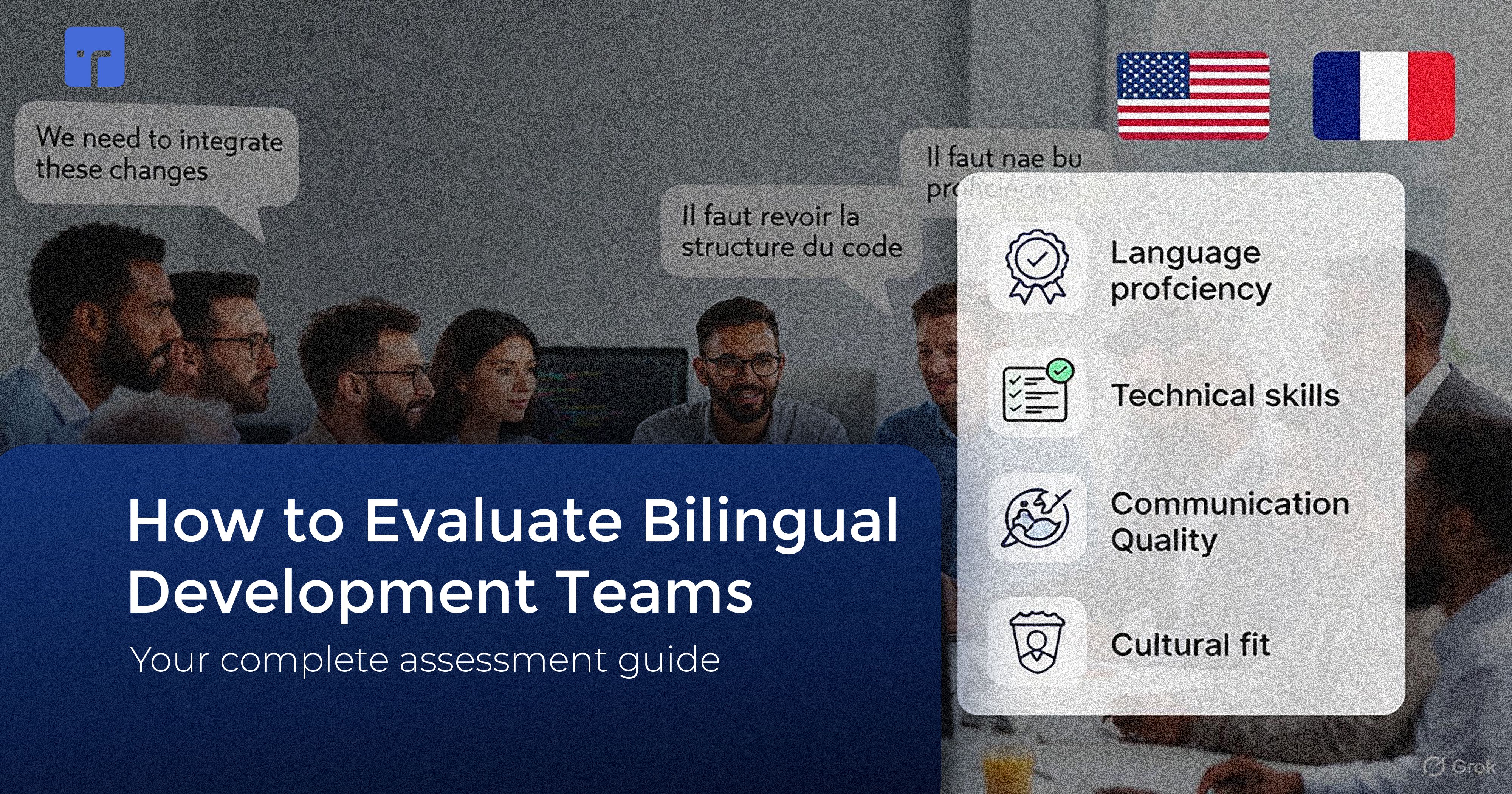
How to evaluate bilingual development teams for software projects
Managed Teams
Hiring African Developers
Let's be honest, finding the right software development team can feel like speed dating in the dark. You're trying to assess technical chops, cultural fit, communication styles, and project management prowess, all while wondering if you'll end up in a relationship that lasts or one that crashes and burns before the MVP is ready.
Now throw language barriers into the mix, and things get even trickier. Or do they?
Here's a plot twist: bilingual development teams aren't just solving the language problem—they're revolutionizing how global software projects actually work. If you're still evaluating teams based purely on coding skills and hourly rates, you're missing the secret weapon that's transforming project delivery speeds, cultural intelligence, and bottom-line results.
The Hidden Cost of Monolingual Teams (That Nobody Talks About)
According to McKinsey, 87% of companies reported gaps in their IT departments, with communication challenges being a primary contributor to project bottlenecks. But here's what most project managers don't realize: these aren't just "language issues", they're strategic vulnerabilities that bleed time, money, and momentum.
Think about the last time your offshore team delivered something that technically met the specs but completely missed the mark on what you actually needed. That wasn't a technical failure, it was simply a communication breakdown disguised as a technical issue.
When basic tasks take longer than usual to the extent that they cause delays, language problems are often the culprit, with team members slow to respond because they're translating or struggling to understand terminology. Traditional teams spend countless hours in clarification loops, misinterpreted requirements, and rework cycles. It's death by a thousand paper cuts.
Why Bilingual Teams Are Your Competitive Advantage (Not Just a "Nice-to-Have")
The software localization market is exploding. With the global software localization market projected to reach $7.06 billion by 2031 and app localization services expected to hit $16.7 billion by 2032, companies are scrambling to capture international markets. But most are still treating localization as an afterthought—a post-launch scramble to translate strings and hope for the best.
Enter bilingual managed teams: developers who don't just speak two languages, but think in two cultural contexts simultaneously. These professionals have been shown to improve communication and collaboration between team members who speak different languages, as all team members can understand each other without language barriers.
But the benefits go way beyond just avoiding awkward miscommunications. Bilingual teams enable continuous localization, where translations happen in parallel with development rather than sequentially, allowing simultaneous global launches where all language versions release together.
That's not just faster, it's a fundamentally different approach to building software for global markets. Your competitors are launching in English and "figuring out" other markets later. You're launching everywhere, all at once, with culturally-nuanced products that feel native from day one.
The 7 Essential Criteria for Evaluating Bilingual Development Teams
So how do you separate the truly bilingual, culturally intelligent teams from those who just put "English: Fluent" on their resumes? Here's your evaluation framework.
1. Language Proficiency (But Make It Strategic)
Here's where most companies get it wrong: they assume any level of bilingualism is helpful. Not quite.
According to CareerBuilder, 57% of hiring managers have caught candidates misrepresenting themselves on their resumes, making language testing particularly important. You need to test for three distinct communication types:
- Technical documentation literacy: Can they read API docs, technical specifications, and architectural diagrams in both languages?
- Real-time verbal communication: How well do they handle sprint planning, stand-ups, and technical debates when things get heated?
- Written asynchronous communication: Are their Slack messages, code comments, and pull request descriptions clear in both languages?
Pro tip: Don't just take their word for it. Administering oral, written, and communication proficiency tests may seem awkward at first, but it's well worth it, especially in a tight job market. During interviews, switch languages mid-conversation. Ask them to explain a complex technical concept in one language, then have them summarize it in another. Watch for hesitation, accuracy, and whether nuance gets lost in translation.
2. Cultural Intelligence (The Real Differentiator)
Language is just the surface. The real magic happens when developers understand the cultural context behind the code.
Being exposed to various languages helps bilinguals develop a heightened sense of empathy, allowing them to connect more profoundly with colleagues and clients from different cultural backgrounds. This isn't just touchy-feely stuff, it translates directly into product decisions.
When your team understands that date formats, currency displays, and even color symbolism vary wildly across markets, they build those considerations into the architecture from day one. Companies can expand their market reach by creating products that cater to multiple languages and cultures, allowing them to access new markets and potential customers.
Evaluation questions to ask:
- "Tell me about a time when cultural differences impacted a technical decision on your project."
- "How would you design a payment flow for users in both Western and Asian markets?"
- "What assumptions do most developers make that don't translate across cultures?"
The best answers won't just acknowledge differences instead they'll show how the developer actively designs for cultural flexibility.
3. Collaboration Velocity (Speed Matters)
Research from the 2024 DevOps Research and Assessment (DORA) report reveals that poor team structures cost companies 23% more in project expenses and deliver features 60% slower than optimized teams. Bilingual teams collapse these inefficiencies.
Here's what to evaluate:
Real-time problem solving: How quickly can they pivot between discussing requirements with your English-speaking product team and clarifying technical details with a Spanish-speaking QA engineer? The answer should be "instantly."
Documentation fluency: Continuous localization removes manual steps like stripping strings out of code for translation and manually copying them back, saving significant time and effort for developers. Ask to see examples of their technical documentation. Is it bilingual by default? Do they maintain parallel wikis, or have they designed a single source of truth that works across languages?
Timezone adaptability: Most LATAM countries are located in time zones that are either the same as or only a few hours different from those in the U.S., allowing distributed teams to connect throughout the workday and address issues immediately. This real-time collaboration eliminates the painful handoff delays that plague offshore teams.
4. Technical Competence (Still Non-Negotiable)
Being bilingual doesn't excuse mediocre code. Quantitative performance assessment criteria typically include code quality, project completion rate, and productivity, measured using automated tools or project management software.
Look for teams that balance language skills with solid engineering fundamentals:
- Code review quality: Can they spot issues and provide constructive feedback in both languages?
- Architecture decisions: Do they design systems with internationalization (i18n) and localization (l10n) baked in from the start?
- Testing rigor: Are their test suites comprehensive enough to catch language-specific edge cases?
Beyond technical skills, evaluate their motivation for continued learning of additional programming languages and frameworks. The same curiosity that drives someone to master multiple human languages often translates into technical polyglotism.
5. Communication Infrastructure (Tools and Processes)
Collaboration and communication are essential for effective software development, as they enable the team to share ideas, solve problems, coordinate tasks, and align expectations. But bilingual teams need the right infrastructure to shine.
Evaluate their tech stack:
- Do they use collaboration tools that support multilingual communication seamlessly?
- How do they handle documentation versioning across languages?
- What's their approach to code comments—bilingual, English-only, or contextual?
Rather than emailing tasks left and right, successful teams utilize ticketing systems and focus on one topic per task, using simple language that everyone understands while shying away from slang.
6. Problem-Solving Agility (The Cognitive Advantage)
Here's where bilingual teams truly differentiate themselves. Knowing two languages makes your brain more flexible; switching between two sets of grammar rules, vocabulary, tones, and nuances makes you quicker at thinking on your feet, better at workplace problem solving, and a whiz at multitasking.
This isn't just theoretical, research shows that bilingual individuals demonstrate superior problem-solving abilities, enhanced creativity, and stronger communication skills, all top priorities for employers according to the NACE Job Outlook 2024 survey.
During evaluation, throw curveballs. Change requirements mid-conversation. Ask them to explain the same solution from different stakeholder perspectives. Watch how they adapt.
7. Long-Term Scalability (Think Beyond the First Sprint)
Organizations with well-structured development teams are 4.5 times more likely to be top performers, with key benefits including reducing project costs by up to 23% and accelerating feature delivery by 60%.
Ask about their team structure:
- How do they onboard new bilingual developers?
- What's their approach to knowledge transfer across languages?
- How do they handle team growth without losing their bilingual advantage?
The chance to move into a different position within a company can be sensitive for bilingual employees—their language skills shouldn't define them, so they should be mentored, trained in leadership, and included in succession planning.
The Tribesquare Difference: Bilingual Managed Teams That Actually Work
Let's cut through the noise: finding individual bilingual developers is one thing. Building a cohesive, high-performing bilingual managed team is something else entirely.
At Tribesquare, we don't just hire people who speak two languages, we build teams where bilingualism becomes a strategic multiplier. Our managed team approach means:
Pre-vetted language and technical skills: Every developer goes through rigorous bilingual technical assessments before joining any project.
Cultural training and context: We don't assume language proficiency equals cultural intelligence. Our teams receive ongoing training in cross-cultural collaboration.
Built-in collaboration infrastructure: From day one, your bilingual team comes with established processes, tools, and workflows optimized for multilingual development.
Continuous performance optimization: We assess team performance through goals, collaboration quality, skill development, and overall impact, ensuring your team isn't just bilingual—they're exceptional.
The ROI of Getting This Right
Let's talk numbers because that's what actually matters. Bilingual employees often earn between 5% to 20% more per hour than monolingual peers, and about one in four companies has faced business setbacks due to a lack of bilingual talent.
But here's the flip side: companies that invest in bilingual teams see massive returns. The right multilingual software development process increases the efficiency of your localization process, can reduce your translation budget, and improves the user experience for international users.
Translation: You're not just hiring developers—you're eliminating entire categories of waste from your development cycle.
Companies using continuous localization report significant competitive advantages, responding to market demands in real-time, iterating based on user feedback across all regions simultaneously, and maintaining feature parity across language versions.
Your Next Move: From Evaluation to Partnership
Here's the uncomfortable truth: if you're still evaluating development teams based purely on technical skills and hourly rates, you're optimizing for the wrong metrics. The real question isn't "Can they code?" It's "Can they accelerate our global ambitions while maintaining quality and cultural relevance?"
Bilingual managed teams aren't just a solution to the language barrier problem. They're a strategic asset that compounds over time—faster iteration cycles, deeper market understanding, and built-in scalability for international growth.
The evaluation framework we've outlined here isn't just a checklist—it's a lens for seeing what's possible when language skills and technical excellence converge. Beyond speaking multiple languages, bilingualism boosts cognitive flexibility, cultural awareness, and job market value, often leading to higher pay and better career prospects.
Ready to stop treating bilingualism as a "nice-to-have" and start leveraging it as your competitive advantage? Get a managed team from Tribesquare that brings both linguistic fluency and technical excellence to your next project. Because in 2025, the question isn't whether you can afford bilingual talent—it's whether you can afford not to have it.
Key Takeaways:
- Bilingual development teams deliver 60% faster feature deployment through continuous localization
- Language proficiency must be tested across technical, verbal, and written contexts
- Cultural intelligence matters as much as coding skills for global products
- Real-time collaboration across languages eliminates costly handoff delays
- Bilingual developers show superior problem-solving and multitasking abilities
- Managed bilingual teams provide built-in scalability and performance optimization
- The global software localization market will reach $7.06 billion by 2031
The future of software development is multilingual, multicultural, and moving fast. Make sure your team evaluation process keeps pace.