Best Tools for Managing African Offshore Development Teams
Productivity and Tools
There is a specific kind of 3 AM panic that CTOs know well.
You wake up and check Slack. Your offshore team has been blocked for six hours on a deployment issue nobody escalated. By the time you see it, London is half a day behind and the sprint review is in four hours. You think: why didn't we have a better system for this?
If that story sounds familiar, this post is for you.
Managing any distributed engineering team is hard. Managing one spread across African time zones, specifically across Lagos, Nairobi, Accra, or Cape Town, comes with its own particular texture. The good news is that Africa's offshore development scene has matured dramatically. The software teams coming out of Nigeria, Kenya, Ghana, South Africa, and Egypt today are not the "cheap outsourcing" story from a decade ago. They are mid-to-senior engineers who have built fintech platforms at scale, shipped products for Silicon Valley startups, and competed on global hackathon leaderboards.
But none of that talent converts to business value without the right tooling and the right workflow design around it.
This post breaks down the actual tools that work, why they work specifically for African offshore teams (which is a subtly different question than "what works for remote teams generally"), and the thinking behind building a management layer that respects both the talent and your delivery timelines.
First, Why "African Offshore" Is a Different Conversation
Most offshore tooling guides are written from a Southeast Asian or Eastern European lens. They assume 6 to 12-hour timezone gaps, they reference call centers and large factories of contractors, and they treat offshore as a cost-reduction strategy.
African offshore development does not fit neatly into that frame.
Here is what makes it distinct:
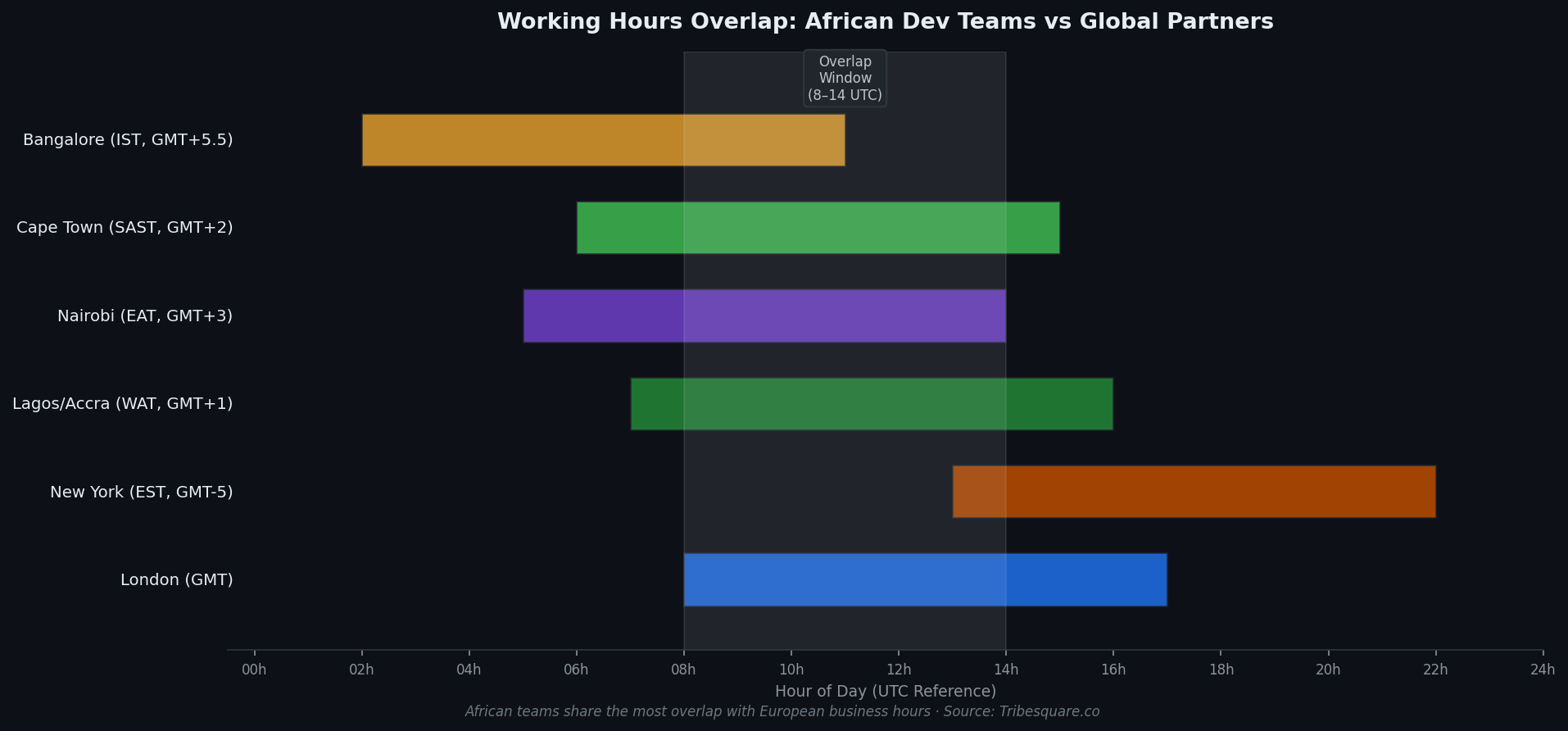
The timezone math is actually favorable. Lagos runs at GMT+1. Nairobi at GMT+3. Cape Town at GMT+2. That means a UK-based founder or CTO gets almost full business-hours overlap with their African team. Even for US-based companies on the East Coast, there is a meaningful morning window (8 to 11 AM EST overlaps with 1 to 4 PM in Lagos). This changes the tooling calculus significantly. You do not need to build entirely asynchronous workflows. You can run real standups.
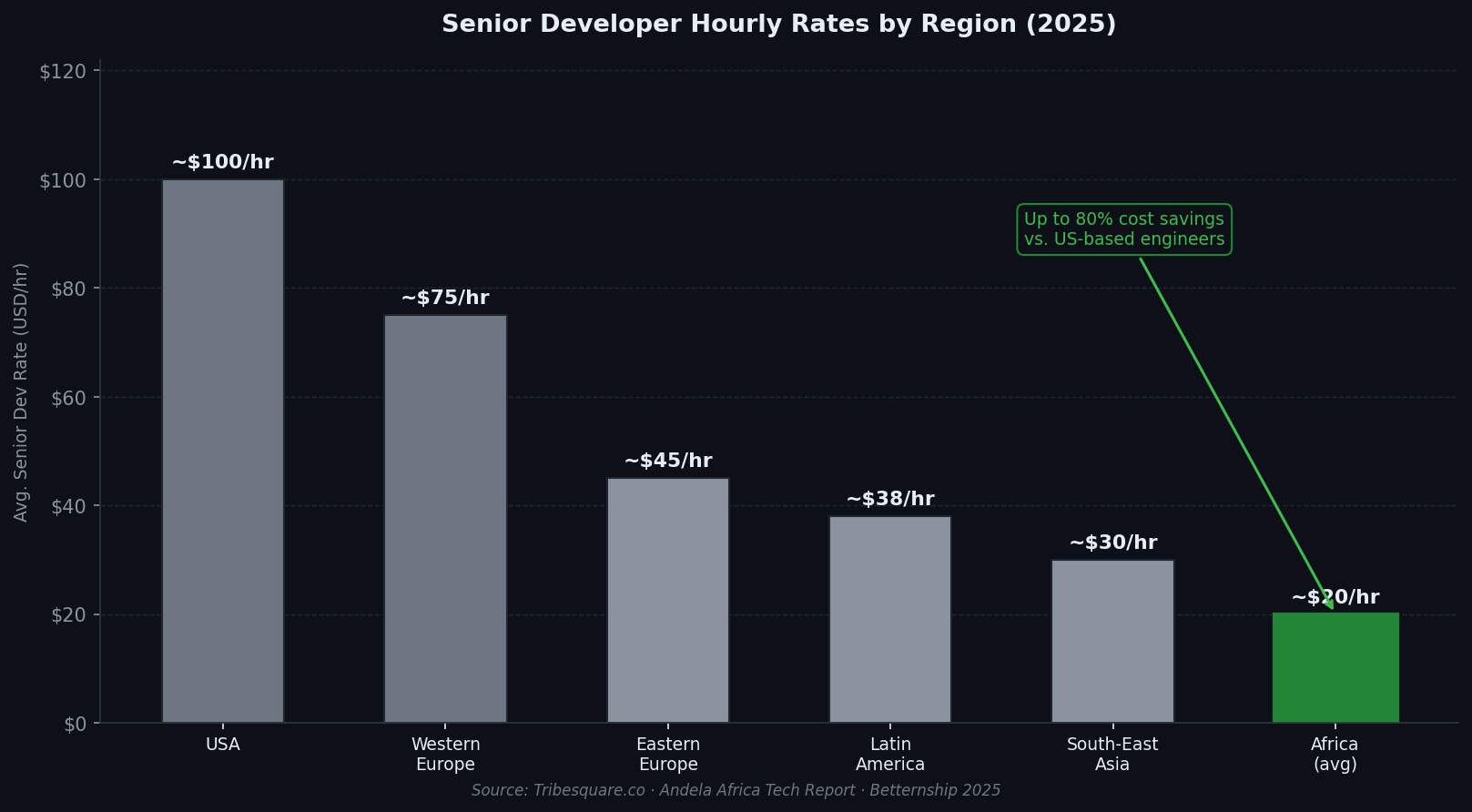
The talent profile is mid-market, not commodity. African developers typically charge between $10 and $30 per hour, compared to US developers who charge anywhere between $50 and $100 per hour. But the story is not just cost. African developers average 4 to 6 years of experience, with expertise in Python, JavaScript, and cloud technologies. You are not staffing a support queue. You are building a product team.
Africa is now formally competitive. In the 2026 global outsourcing index, South Africa ranks 5th worldwide, followed by Nigeria at 6th, Kenya at 11th, Egypt at 15th, and Ghana at 17th. Several African countries now appear in the global top 20, confirming the emergence of a competitive African bloc in outsourced digital services.
This is the landscape you are working in. Now let us talk about the tools.
The Tooling Philosophy: Build for Trust, Not Surveillance
Before diving into specific platforms, there is a mindset shift worth naming.
A lot of offshore management culture is built on surveillance. Time tracking screenshots. Keystroke loggers. "Productivity scores." This approach destroys team morale, attracts the wrong kind of talent, and communicates distrust before the first sprint is even planned.
The better frame, especially for African engineering talent, is to build systems that create visibility without creating anxiety. You want your team in Lagos to know exactly what success looks like every week, have the tools to show you their progress clearly, and feel trusted enough to flag a blocker on a Tuesday rather than letting it quietly sink a sprint.
That is the design principle behind every tool recommendation below.
Category 1: Project Management Tools
This is the foundation of your entire offshore workflow. Your project management tool is where expectations are set, tracked, and renegotiated.
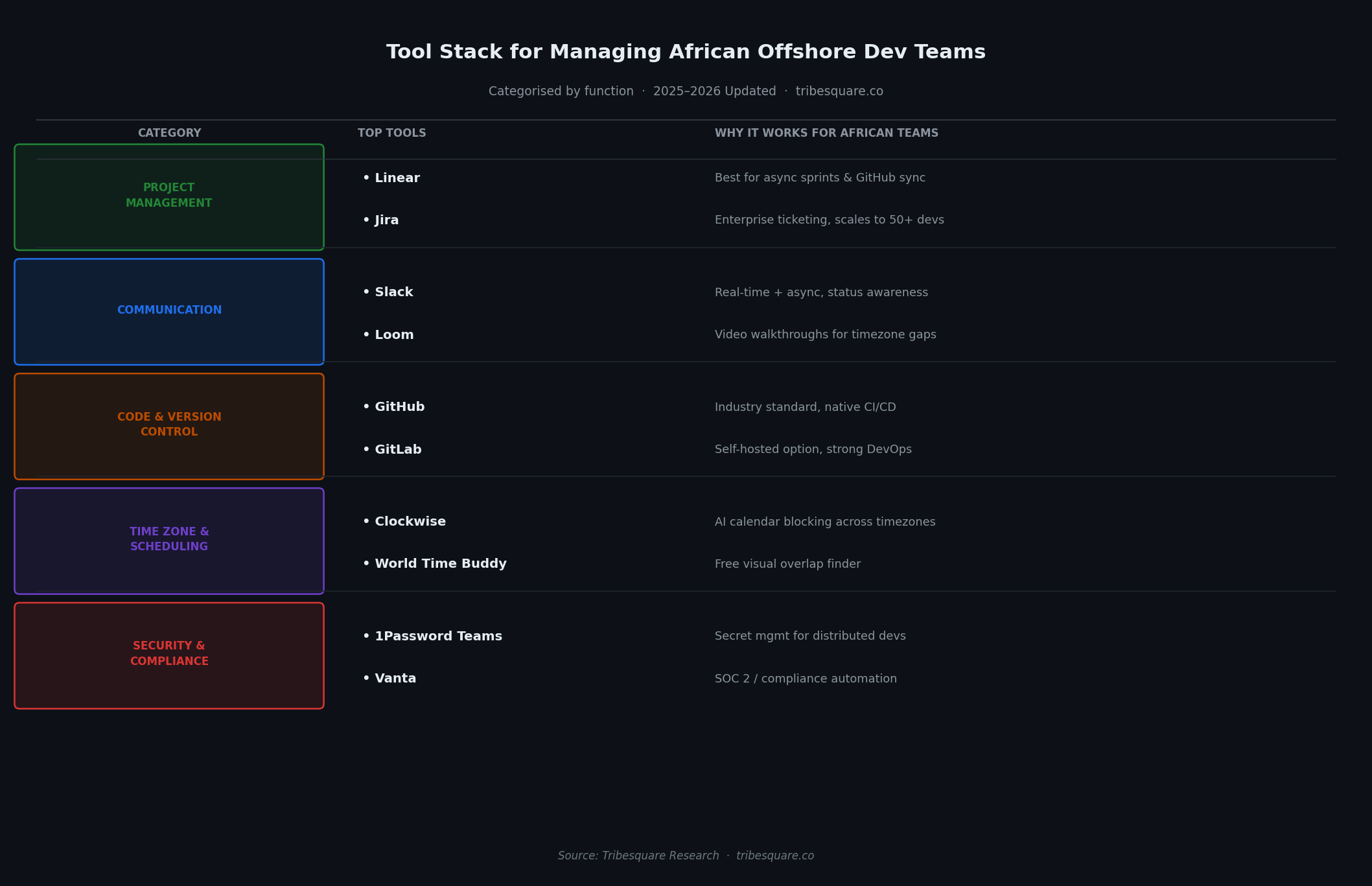
Linear has become the preferred tool for engineering-led teams managing African developers, and for good reason. Its GitHub integration is tight, the sprint structure is genuinely well-designed for small-to-mid squads, and the "no fluff" interface means your Lagos-based team is not wading through feature bloat. For a 3 to 15-person distributed team shipping product fast, Linear is currently the best-in-class option.
Jira is the enterprise workhorse. If your company is already on the Atlassian stack, Jira still works fine, but it requires more deliberate setup for offshore teams. Specifically, you need to be ruthless about your ticket-writing discipline. A vague Jira ticket is a timezone nightmare. Every ticket assigned to an African offshore team member should have a clear definition of done, linked context, and no assumed institutional knowledge.
ClickUp sits in the middle. It bundles task management, docs, time tracking, and goals in one interface. For a founder or technical lead who wants one tool instead of five, ClickUp is genuinely useful. The downside is that its breadth can become noise for engineers who just want to know what to work on next.
Notion deserves a special mention here, not as a Jira replacement, but as the glue layer. The best offshore setups use Notion for architecture docs, onboarding SOPs, team wikis, and decision logs. African engineers who are being onboarded into a global team ramp up dramatically faster when there is a well-curated Notion workspace versus a shared Google Drive folder of PDFs.
The key principle: pick one project management tool and treat it as the single source of truth. Every task, every status update, every blocker lives there. Not in Slack, not in someone's notebook.
Category 2: Communication Tools
Async communication done well is the real competitive advantage of any offshore relationship. But the tools that enable it are only as good as the norms you build around them.
Slack is table stakes, but its value is in the setup, not the download. For African offshore teams, the highest-leverage Slack configuration includes dedicated project channels, a clear escalation channel, and a norms document that defines response time expectations by channel type. A simple rule like "anything tagged @here gets a response within 2 hours during working hours" prevents the panic that comes from not knowing if someone saw your message.
One underused Slack feature for offshore teams: status visibility. Encourage your Nigerian and Kenyan engineers to use working hours and status indicators. This sounds small, but knowing at a glance whether someone is in a meeting, unavailable, or heads-down coding eliminates dozens of "hey, are you there?" messages a week.
Loom is not a communication tool in the traditional sense, but it is one of the highest-leverage tools in the offshore management toolkit. When your Cape Town team lead needs to walk through a new architecture decision, a 4-minute Loom video with screen recording does more work than a 400-word Slack message or a scheduled Zoom that nobody fully attends. For technical review, onboarding new engineers, or giving feedback on a PR, Loom collapses the context transfer problem that kills offshore productivity.
Google Meet or Zoom for synchronous standups and sprint ceremonies. For African teams with GMT+1 to GMT+3 alignment, you can absolutely run real 15-minute daily standups with your European team and have meaningful interaction. Do not give up on synchronous communication entirely. It builds the relationship that makes everything else work.
Gather.town is worth mentioning for teams that want to create more ambient presence across geographies. It mimics a virtual office layout where people can "walk up" to each other. For teams where cultural integration matters, which it does when you are working with African engineers who bring strong collaborative instincts to the workplace, Gather gives distributed teams a sense of shared space that Zoom calls cannot replicate.
Category 3: Code Collaboration and Version Control
This category gets less attention in management articles but is arguably the most operationally critical for African offshore teams.
GitHub is the non-negotiable starting point. Beyond just version control, GitHub's project boards, pull request review workflows, and Actions pipeline are the invisible infrastructure of a well-run offshore engineering team. The code review process, specifically how you give feedback on pull requests, is one of the most important culture signals you send to your offshore team. PR comments that are detailed, constructive, and timely tell your Nairobi-based engineer that you respect their work. One-line dismissals do the opposite.
A specific pattern that works well: set up branch protection rules that require at least one review from someone in a different timezone before merging. This forces cross-timezone code review loops and prevents the offshore team from shipping in isolation.
GitLab is the alternative for teams that want self-hosted infrastructure or stronger built-in CI/CD. For companies with compliance requirements around where code lives, GitLab's self-hosted option lets you run infrastructure that satisfies legal requirements while keeping the collaboration workflow clean.
Linear's GitHub integration is worth calling out specifically: when you link Linear tickets to GitHub PRs, you get automatic status updates as PRs open, review, and merge. This closes the loop between your project management and your code without anyone having to manually update a ticket.
Category 4: Time Zone and Scheduling Tools
This is the category that nobody talks about enough, and it causes more project friction than almost anything else.
Clockwise is an AI-powered calendar tool that automatically blocks focus time, moves meetings to minimize disruption, and gives your team visibility into each other's availability across timezones. For a technical lead managing engineers across Lagos and London, Clockwise prevents the death-by-meeting pattern that makes offshore engineers feel like their workday is not their own.
World Time Buddy sounds almost too simple, but having a shared bookmark to worldtimebuddy.com with your core team timezones saved is something every distributed engineering lead should do on day one. Before you schedule any call, open it. The number of times a "quick sync" gets scheduled at 11 PM in Nairobi because someone did not check is a real and avoidable problem.
Cal.com is the open-source scheduling tool that respects everyone's timezone and working hours. Instead of the back-and-forth of finding a mutual time, you share a Cal link that already knows your team's availability rules. For African engineers who often juggle multiple client relationships, this removes friction from the coordination layer.
Reclaim.ai goes further than Clockwise by also protecting time for deep work, habits, and one-on-ones. For senior African engineers who are doing both IC work and leading junior teammates, Reclaim prevents the calendar fragmentation that burns people out.
Category 5: Security and Compliance Tools
This is where many offshore setups are weakest, and it is also where the consequences of getting it wrong are most severe.
1Password Teams is the standard for distributed teams managing shared credentials and secrets. African offshore teams working on global products need to be provisioned with properly scoped access from day one, not added to a shared spreadsheet of passwords. 1Password's access controls, audit logs, and secret sharing workflows handle this cleanly.
Vanta automates SOC 2 compliance evidence collection. If your product is in a regulated space and your African offshore engineers have access to production systems, Vanta makes it operationally feasible to maintain compliance without creating a bureaucratic nightmare for the engineering team.
NordLayer is a business VPN solution that handles the Africa-specific infrastructure reality honestly. Internet infrastructure varies across African countries. NordLayer's network optimization routes traffic intelligently, and its zero-trust access model lets you provision offshore engineers with exactly the access they need, nothing more. For companies managing development across multiple African cities, this matters.
Doppler is the secrets management layer that prevents the worst offshore security failure pattern: developers storing API keys in .env files or Slack messages. Doppler syncs secrets across environments programmatically. It is a one-time setup that eliminates an ongoing risk.
The Tool Nobody Talks About: A Great Partner on the Ground
Here is the honest truth that no tool comparison article will tell you.
The highest-leverage "tool" for managing an African offshore development team is not software. It is a trusted local partner who understands the talent market, vets engineers rigorously, handles the employment compliance, and gives you a reliable escalation path when something goes wrong.
That is exactly the problem that Tribesquare was built to solve.
Tribesquare provides fully-managed engineering teams to growing businesses in Africa and across the world, connecting companies to vetted developers with rigorous screening that goes beyond resumes to test technical skills, soft skills, and cultural fit.
When you are a CTO at a UK or US company trying to build a product team in Africa, the hardest part is not the tooling. It is knowing whether the engineer you are hiring actually has the experience they claim, whether they will communicate proactively, and whether they will stay. Tribesquare's vetting pipeline addresses all three.
Tribesquare offers three engagement models: talent sourcing for individual engineers, fully co-managed teams for companies that want a squad without the HR overhead, and end-to-end product development for founders who want to hand off the build entirely.
Global companies building faster and smarter are not doing it by pasting together a dozen freelancer profiles from job boards. They are doing it by partnering with organizations that have already done the hard work of identifying, training, and managing Africa's finest engineers.
If you are serious about building an African offshore team that actually ships, the conversation starts at tribesquare.co
Putting It Together: The Minimum Viable Tech Stack
You do not need every tool on this list. Here is a practical starting point for a team of 3 to 8 African offshore engineers:
For a 3 to 5 person squad just starting out:
- Linear for project management
- Slack for communication
- Loom for async technical walkthroughs
- GitHub for code collaboration
- World Time Buddy bookmarked in every browser
- 1Password Teams for credentials
That is six tools. Get them working well before you add anything else.
For a 6 to 15 person team in a growth phase:
Add Notion for your team knowledge base, Clockwise for calendar intelligence, Vanta if you are in a regulated space, and Doppler for secrets management.
The pattern is deliberate simplicity first, then layered tooling as the team grows into it. Nearly 93% of organizations have adopted cloud-based tools to streamline outsourcing coordination, but the value comes from disciplined implementation, not tool count.
The Conversation Nobody Is Having About African Offshore Teams
The tool conversation matters, but there is a bigger shift happening that CTOs and founders should register.
Africa is not just a cost-arbitrage play anymore.
Between 2014 and 2024, Andela trained over 110,000 technologists representing 15% of Africa's engineers, and Nigeria's technical talent pool grew by 791% since January 2020, while Kenya's grew by 451% and Ghana's by an impressive 955%.
Tech investment in Africa grew by 46% in 2025, with fintech firms receiving the most funding and AI and e-commerce emerging as the next fastest-growing sectors.
The engineers you are hiring to work on your product today are the same people building the next wave of African unicorns. They are not passive contractors waiting for tickets. They are builders with context, ambition, and strong engineering fundamentals.
The right tool stack does not manage this talent. It creates conditions where this talent can do its best work and choose to stay.
That is the frame that separates the CTOs who build great African offshore teams from the ones who churn through contractors and wonder why nothing sticks.