
Best Country to Outsource Software Development in 2026: An Honest Comparison
Hiring African Developers
There are dozens of articles that will tell you the best country to outsource software development. Most of them have one thing in common: they are written by outsourcing companies promoting their own region. The Indian agency ranks India first. The Ukrainian shop ranks Ukraine. The LATAM firm leads with Colombia or Argentina. This is to some extent normal, especially when each articles strategically gives good reasons why these regions deserves to be the best.
This article is written by a global engineering software outsourcing company - based in Africa. We will tell you when Nigeria is the right answer. We will also tell you when it is not.
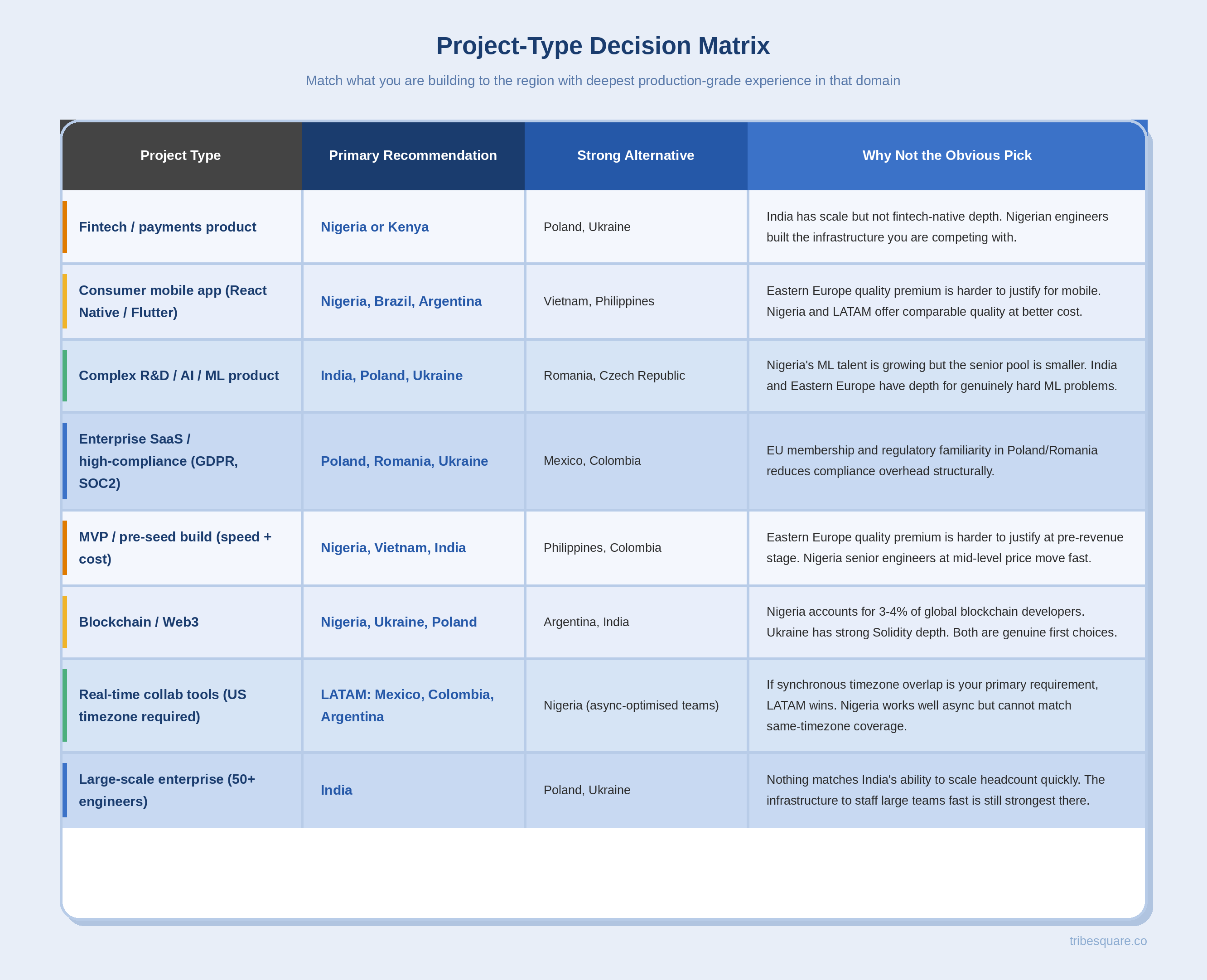
The decision matrix at the centre of this piece is built around one question that every other comparison article ignores: what kind of product are you building, and which country has the deepest and most battle-tested expertise in that specific domain?
Geography, timezone, and cost are real variables. But none of them matter as much as whether the engineers you hire have shipped something comparable to what you need. That is the filter that cuts through the marketing.
Why the Standard Comparison Fails You
The typical structure of a 'best country to outsource' article would essentially list eight to twelve countries, describing each with their rate ranges and a bullet list of pros and cons, and eventually conclude with a generic recommendation to consider your specific needs. We want to be comprehensive with our approach by unequivocally analyzing the contextual and determining factors around hiring software engineers from different regions.
Building a fintech product with payment rails, wallet logic, and regulatory compliance is not the same project as building a React Native consumer app. Building an ML pipeline for a healthcare platform is not the same project as building a SaaS admin dashboard. The engineers who are best placed for one of those are not necessarily best placed for the other. A country with a world-class fintech engineering ecosystem is irrelevant if you are building something that has nothing to do with fintech.
The right frame is not 'which country is best' but 'which country has the deepest production-grade experience in my specific domain?' That question produces a completely different ranking depending on what you are building, and it is the only ranking that matters.
The global IT outsourcing market was worth $302.62 billion in 2024 and is projected to reach $525 billion by 2030 at a 9.8% CAGR. The scale of the market means the quality variance between good and bad outsourcing decisions is also enormous. Getting the geography right is the first filter before you evaluate vendors, pricing, or team structure.
The Region-by-Region Snapshot: What Each Actually Delivers
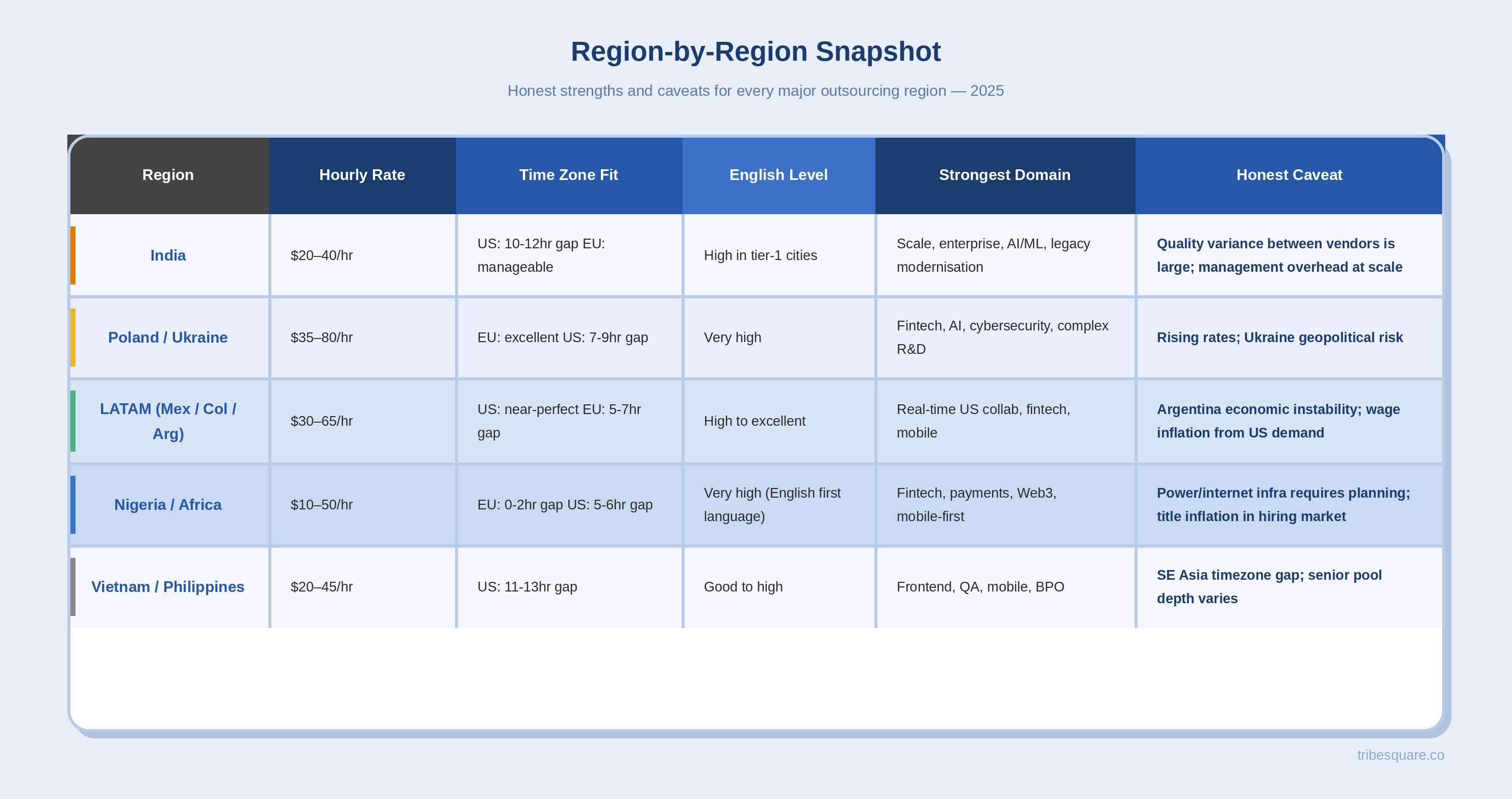
India: Scale that nothing else matches, with known tradeoffs
India has over 5 million software engineers, produces 1.5 million engineering graduates per year, and its outsourcing industry is the most mature in the world. For large-scale enterprise projects, AI/ML platforms, legacy modernisation, and cloud migration, India remains the default choice for a reason. Nothing else scales headcount from 5 to 50 engineers as quickly.
The real caveats: quality variance between vendors is significant. The difference between a top-10% Indian engineering team and a mid-market one is larger than in almost any other outsourcing market. Management overhead is real most successful India engagements require a dedicated technical lead on the client side. And timezone friction with US clients (a 10 to 12 hour gap) means synchronous collaboration requires deliberate design.
Who should use India: companies needing large teams quickly, projects requiring deep AI/ML expertise, enterprise clients with a technical PM in-house who can manage vendor relationships.
Eastern Europe: The quality ceiling is the highest
Poland, Ukraine, and Romania produce engineers with genuinely deep technical education, strong R&D instincts, and domain expertise in fintech, cybersecurity, and complex systems. Poland has the largest number of AI companies in Europe — 301 — and Ukrainian developers have among the strongest credentials in AI and ML globally. For complex, algorithm-heavy, or high-security projects, Eastern Europe sets the ceiling.
The real caveats: rates are rising. Polish senior engineers are approaching the price of US mid-level engineers at certain experience levels. Ukraine carries geopolitical risk that any honest engagement model has to account for. For companies that require EU data residency or GDPR compliance built into the engineering culture, Poland and Romania have a structural advantage they live and breathe EU regulation in a way that offshore engineers in other regions do not.
Who should use Eastern Europe: European companies who need GDPR compliance embedded in the team, companies building products with complex algorithm requirements, security-sensitive applications, companies for whom quality ceiling matters more than cost.
Latin America: The US timezone advantage is real
Mexico, Colombia, and Argentina offer something no other outsourcing region does for US-based companies: near-perfect timezone overlap. US buyers tend to favour Latin America for synchronous collaboration and the region has earned that preference. If your engineering process depends on real-time standups, quick feedback loops, and frequent synchronous pairing, LATAM removes the timezone friction entirely.
The real caveats: Argentina's economic volatility is a real planning risk for long-term contracts. Rates in LATAM have risen faster than Africa and parts of Asia due to strong US demand the nearshore premium is real. And the talent pool, while skilled, is smaller than India or Eastern Europe at the senior level.
Who should use Latin America: US startups and scaleups who need daily synchronous collaboration, companies where timezone overlap is a genuine product requirement, teams that found India's timezone difficult and want a nearshore alternative.
Nigeria and Africa: The fintech and mobile depth is genuine
Nigeria rose from rank 20 to rank 11 globally on GitHub between 2020 and Q4 2024. Over 1.1 million developers are building on GitHub in Nigeria, with 28% year-on-year growth. The fintech ecosystem produced Paystack (acquired by Stripe for $200 million), Flutterwave ($3 billion valuation), and Moniepoint ($1 billion valuation). The engineers who built those products are in the local talent market.
For fintech, payment systems, wallet architecture, blockchain, and mobile-first products targeting emerging market dynamics, Nigeria offers a level of production-grade problem-solving experience that no other outsourcing market replicates. The engineers have built payment infrastructure that handles more complex constraints than most Western payment systems face.
The real caveats: power and internet infrastructure require planning around. Title inflation in the hiring market means structured vetting is essential. For genuinely large-scale enterprise projects (50+ engineers), the ecosystem depth to staff quickly is not at India's level. For European companies, the timezone gap is 0 to 2 hours — a structural advantage. For US companies, the gap is 5 to 6 hours and requires async-first discipline.
Who should use Nigeria/Africa: companies building fintech or payment products, startups who need high-quality engineers at a cost that works at seed or Series A, European companies who want African timezone coverage, companies building for the African market.
Vietnam and the Philippines: Frontend depth and communication quality
Vietnam produces strong frontend and mobile engineers at competitive rates. The Philippines is exceptional for communication heavy roles, frontend development, QA, and client-facing platform work with some of the strongest English proficiency and Western cultural alignment in Asia. Both markets have growing depth but face the same time zone challenge for US and European clients: an 11 to 13 hour gap that makes synchronous work genuinely difficult.
Who should use SE Asia: companies with async-first cultures who can absorb the timezone gap, projects where frontend depth and communication quality are the primary requirements, companies scaling QA teams quickly.
The Decision Matrix: Match Your Project Type to the Right Country
This is the table that does not exist anywhere else in this content space. Every 'best country' article lists countries. None of them has built a project-type-to-country recommendation that is honest about when each geography wins and why.
The Three Variables Most Guides Get Wrong
1. Time zone is a process question, not a binary constraint
The standard comparison treats time zone overlap as a hard requirement. It is not. It is a process design question. Teams that work async-first with documented decision-making, clear sprint ownership, and deliberate communication protocols can function effectively across a 12-hour time zone gap. Teams that have not designed for async will struggle even with a 2-hour gap.
The honest question is not 'how much timezone overlap does this country give me?' but 'is my team structured to work async, or do we require synchronous collaboration to function?' If the answer is the second option, choose LATAM regardless of which geography has the best engineers for your domain.
2. Hourly rate is the wrong cost metric
Deloitte's 2024 outsourcing survey found that 70% of businesses cited cost savings as their primary outsourcing driver in 2020. By 2024, only 34% cited cost as the primary driver. The market has matured because enough companies have learned that cheap hourly rates and low total cost of engagement are not the same thing.
A senior Nigerian engineer at $3,500 per month who requires a 2-week ramp, communicates well, and ships cleanly is cheaper than a senior Indian engineer at $2,500 per month who requires a 6-week ramp, generates significant management overhead, and produces code that needs rework. The math is in the total cost: compensation plus ramp cost plus management time plus rework cost. That number varies more by team quality within a geography than by geography itself.
3. Domain expertise compounds over time
An engineer who has built five payment integrations understands payment engineering at a level that cannot be taught in a sprint. An engineer who has built zero payment integrations but is technically strong will get there, but it will cost you onboarding time, decision errors, and the hidden tax of teaching domain knowledge on the clock.
The reason domain expertise is the most important filter in the decision matrix is that it is the variable most correlated with delivery speed and quality on real products. It is also the variable most absent from hourly rate comparisons and country ranking tables.
A Practical Process for Making This Decision
Run through these questions in order. The answers should point you to a geography before you have read a single vendor proposal.
Step 1: What is your primary domain?
Fintech, mobile, enterprise SaaS, AI/ML, Web3, e-commerce, health tech. Map this to the decision matrix above. Shortlist two or three geographies that have genuine production experience in your domain.
Step 2: What is your collaboration model?
Do you need synchronous daily standups and real-time pair programming? LATAM for US companies or Nigeria/Eastern Europe for European companies. Can you work async with documented decisions and async sprint reviews? Any geography works if the team is structured for it.
Step 3: What is your team size requirement?
Under 10 engineers: any geography works. Ten to 50: India, Eastern Europe, or Nigeria. Over 50 with a fast ramp requirement: India or Eastern Europe. The infrastructure to staff large teams quickly is not equally distributed.
Step 4: What is your compliance requirement?
GDPR-embedded engineering: Poland or Romania have the structural advantage. HIPAA or US healthcare compliance: India has the most mature processes. General international contract law: any geography with a professional services agreement. High-security clearance or data sovereignty: stay onshore or in your own jurisdiction.
Step 5: Run a paid pilot before committing
Whatever geography the first four questions point to, validate it with a two-sprint paid pilot on a real piece of work before committing to a full team. The matrix reduces the variance. It does not eliminate it. A pilot sprint is the only way to know whether the specific team you are evaluating matches the quality standard of the geography's best.
One honest observation from running distributed teams: the best outsourced team we have seen did not come from the country that ranks highest for their domain in every comparison table. It came from a specific team, in a specific geography, that had been assembled with specific care around the problem being solved. Geography is a filter. Team quality is the decision.
The Bottom Line
There is no single best country to outsource software development. There is a best country for your specific project type, your collaboration model, your team size, and your compliance requirements. Those four variables together produce an answer that no generic ranking table can give you.
What this article has tried to do is give you the honest version of each region's strengths, the decision matrix to map your project type to the right geography, and the practical process to validate the choice before you commit.
If you are building a fintech product: Nigeria or Kenya, seriously. If you are building a complex algorithm-heavy system for a European enterprise: Poland or Ukraine. If you need daily synchronous collaboration with a US team: LATAM. If you need to scale 50 engineers in 90 days: India. For everything else: run the matrix, pilot the team, and build around domain expertise rather than hourly rates.
Building Something? Let's Match You to the Right Team.
Tribesquare is an African engineering agency that has run engagements for US, UK, and European companies across fintech, SaaS, mobile, and Web3. We are honest about where Africa wins and where it does not which is why our clients trust us with real products.